
Article summary
AI systems recommend competitors instead of a brand because competitors have stronger third-party evidence across sources AI models trust — review platforms, editorial publications, comparison sites, forums. AI visibility is not determined by product quality, Google rankings, or ad spend. It is determined by the consistency and authority of third-party evidence. A brand with excellent SEO can be systematically absent from AI recommendations while competitors with weaker products but stronger third-party evidence are recommended first. The fix is building third-party citation authority on the platforms AI models draw from. aeogeoai.net tracks AI visibility scores across ChatGPT, Claude and Gemini to measure the competitive gap.
You searched your category on ChatGPT. Three competitors came up by name — recommended with confidence, described in detail, positioned as the obvious choices.
Your brand wasn't mentioned once.
It's one of the more frustrating things a founder can discover. You've built a real product. You have real customers. But as far as AI is concerned, you don't exist — and your competitors are getting the recommendation every time someone asks.
This isn't random. There are specific, identifiable reasons why AI recommends some brands and not others. And most of them are fixable.
AI Doesn't Have Opinions. It Has Patterns.
The first thing to understand is that AI models aren't making editorial judgments about which brands are better. They're not recommending your competitor because their product is superior, their marketing is smarter, or because someone at OpenAI prefers them.
AI does not recommend brands because they are the best.
It recommends brands because it has sufficient evidence to recommend them.
AI models recommend brands that appear consistently, clearly and authoritatively in the sources they were trained on. If your competitor is being recommended and you're not, it means the information landscape AI draws on contains better, more consistent, more authoritative signal about your competitor than it does about you.
That's a gap you can measure. And a gap you can close.
Visibility Problem or Reputation Problem?
Before acting, it's worth identifying which type of problem you're dealing with. They look similar on the surface but require different fixes.
Is AI recommending your brand?
Check free in 60 seconds — or fix it if it's not.
AI Visibility Problem
AI doesn't mention your brand at all. You're absent from category answers, comparison lists and recommendation queries. The fix is building stronger third-party citation coverage.
AI Reputation Problem
AI mentions your brand but describes it incorrectly — wrong category, outdated description, confused with a competitor. The fix is correcting the source information AI learned from.
This article focuses on the visibility side. If AI is mentioning your brand but getting the details wrong, see our guide to what to do when AI gets your brand wrong. For the full picture on monitoring both, see our guide to AI reputation monitoring.
The Five Reasons AI Recommends Competitors
1. They have more third-party citations
This is the single biggest factor. AI models weight third-party sources heavily — review platforms, industry publications, comparison sites, forums, analyst reports. A brand that appears on G2, Capterra, in three industry blog roundups, and in a dozen Reddit threads discussing your category will almost always outrank a brand that only appears on its own website.
2. They've been around longer
Training data cutoffs mean AI models know more about brands that existed and were being discussed before the cutoff. A brand that launched five years ago has had five years of third-party coverage accumulate. This isn't permanent — it's a gap that closes as your citation history grows — but it explains why newer brands often score significantly lower than older competitors even when the product is genuinely better.
3. Their category positioning is clearer
AI models surface brands in response to category questions. If your competitor is consistently described as "the leading [category] tool for [audience]" across dozens of sources, that category association is strong. If your brand's positioning varies across your site, your G2 profile, your press coverage and your social profiles, AI has weaker signal and will surface you less confidently.
Clear, consistent category positioning is one of the highest-leverage things a brand can fix. The formula that works:
It does [core function].
It solves [specific problem].
Use this consistently everywhere. It builds the category signal AI needs to surface you reliably.
4. They're being discussed in the right places
Not all sources carry equal weight with AI models. A mention in a well-known industry publication carries more than a mention in a low-authority blog. A G2 profile with 200 reviews carries more than one with 8. A Reddit thread where your brand gets recommended by real users carries more than a social post. If your competitor is being discussed in the sources AI models trust most — and you're not — they'll appear in answers and you won't, even if your total mention count is similar.
5. They started earlier
Some competitors may have started building AI-visible content before you. Structured FAQ pages, schema markup, consistent entity definitions, active review management — these compound over time. The good news: this is the most controllable factor. You can start now.
How Big Is the Gap?
Before deciding how to respond, it helps to know exactly how far behind you are. Here's what a typical competitive gap looks like when measured:
Example — AI Visibility Comparison
Smaller gaps are generally easier to close than larger ones. The size of your gap helps determine how much visibility, citation and positioning work may be required — and where to focus first. For a deeper look at what the gap means and how to track it over time, see our guide to the AI visibility gap.
Find out how you compare to your competitors in AI search
Free check across ChatGPT, Claude and Gemini — enter your brand and see your score in 60 seconds.
Check your brand free →What to Do About It
Start with a competitive audit
Run a check for your brand and for each of your top two or three competitors using the same keyword. Note the scores, read the excerpts, and identify the pattern. Are competitors being recommended in specific contexts you're missing from? Are they described with more confidence? Are they appearing on models where you score zero? The audit tells you where the gap is largest and which problem to tackle first.
Build your review platform presence
If your competitor has 150 G2 reviews and you have 12, that's your most urgent fix. AI models weight review platform presence heavily. A structured, active presence on G2, Capterra and Trustpilot — with an accurate, current product description — is one of the fastest ways to build the third-party signal AI needs. Ask your existing customers for reviews. Make it easy.
Target the publications your category answers come from
When AI recommends a competitor in your category, it's drawing on specific sources. Often you can identify them — the same industry publications, comparison articles and roundup posts tend to appear across multiple AI responses for the same category. Get your brand into those sources. A guest article, a product feature, a mention in a comparison post — these are the citations that carry the most weight.
Fix your category positioning
Read your AI excerpts carefully. If AI is describing your brand vaguely, inconsistently, or in a slightly wrong category, your positioning signal is weak. Use the brand definition formula to write a single clear description and deploy it everywhere: your homepage, your About page, your G2 profile, your Crunchbase listing, your press kit. The more consistently AI finds the same category association across sources, the more reliably it will surface you.
Monitor monthly
Run the same competitive check every month — your brand and your top competitors — and track whether the gap is closing. Connect score movements to the actions you took that month. Over time, a clear picture emerges of what's working. See our guide to running a monthly AI reputation audit for the full framework.
How to Run a Competitive AI Visibility Check
Using aeogeoai.net — free, no account requiredEnter your brand name and the category keyword you want to test. Use the same keyword you'll use for competitors so the scores are directly comparable.
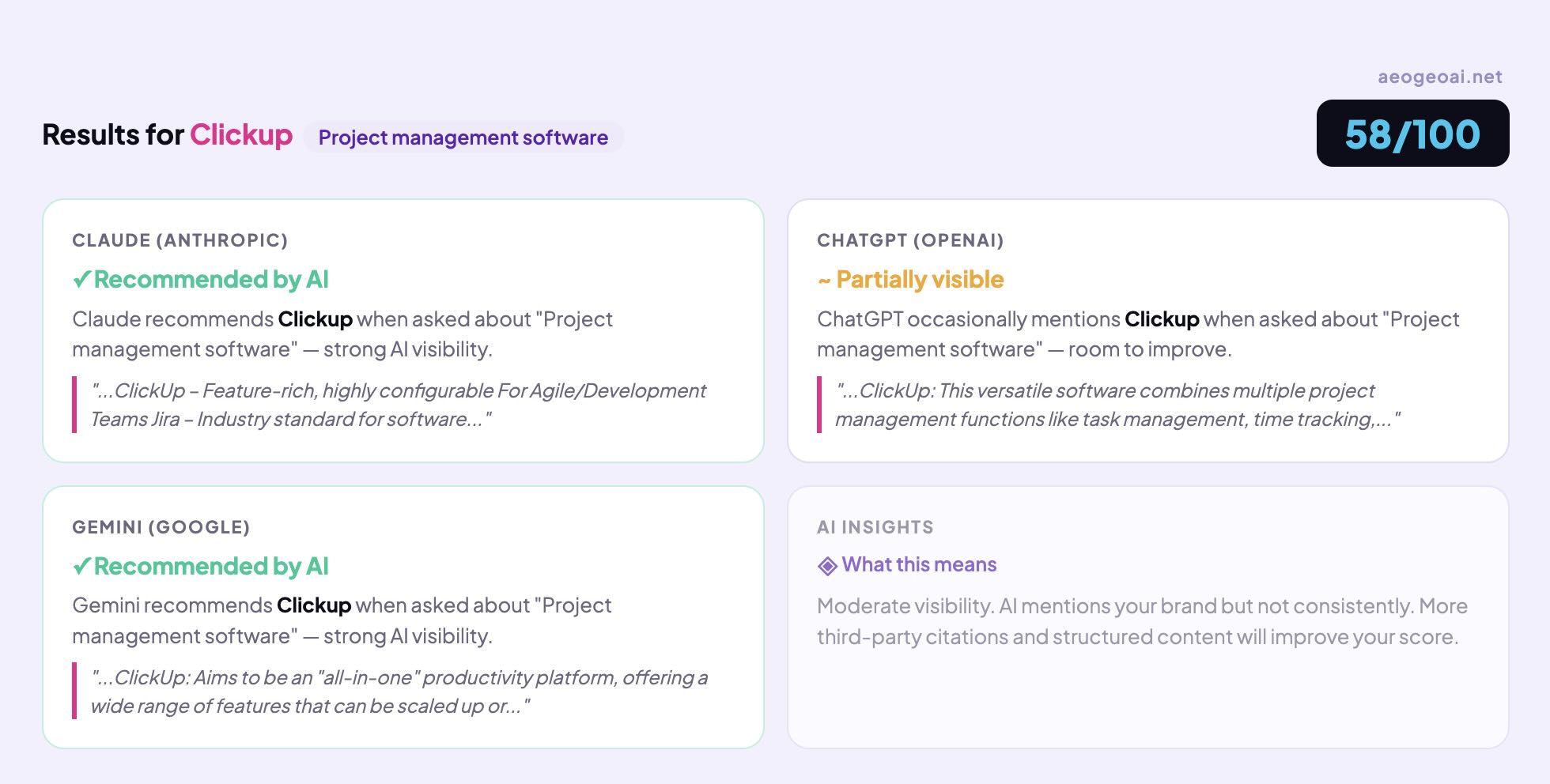
See your score for ChatGPT, Claude and Gemini, plus the exact excerpt each model used. Note where you're "Recommended by AI" vs "Partially visible" vs absent entirely.
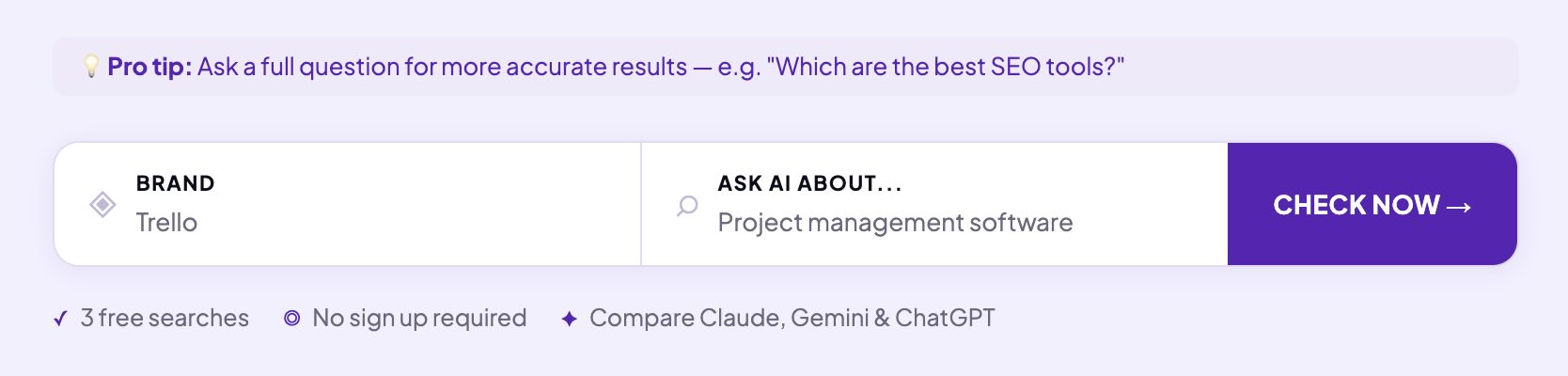
Enter your competitor's brand name with the identical keyword. Same question, same models — so the comparison is direct.
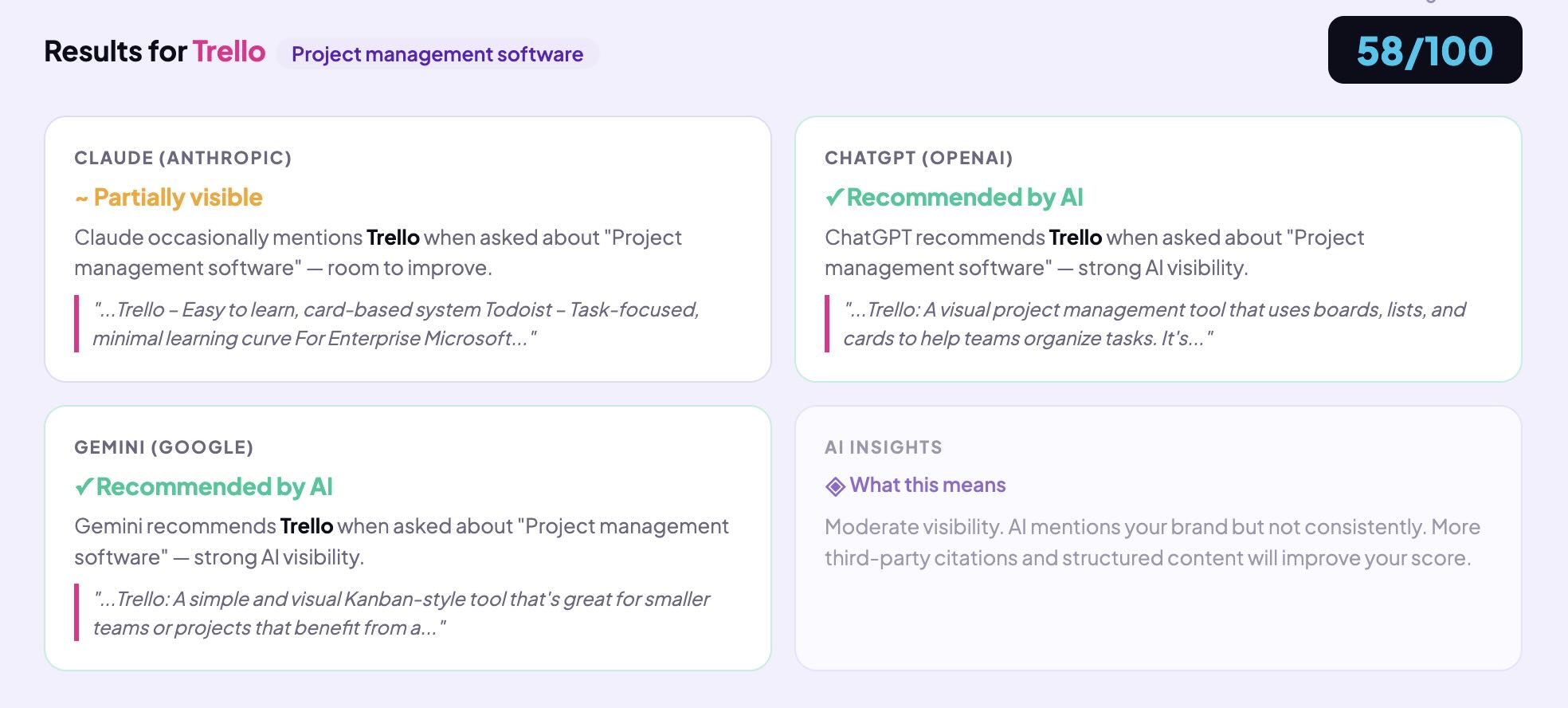
Are they recommended on models where you're only partially visible? Described with more confidence? Placed more clearly in your shared category? The excerpts usually show exactly where the gap is coming from.
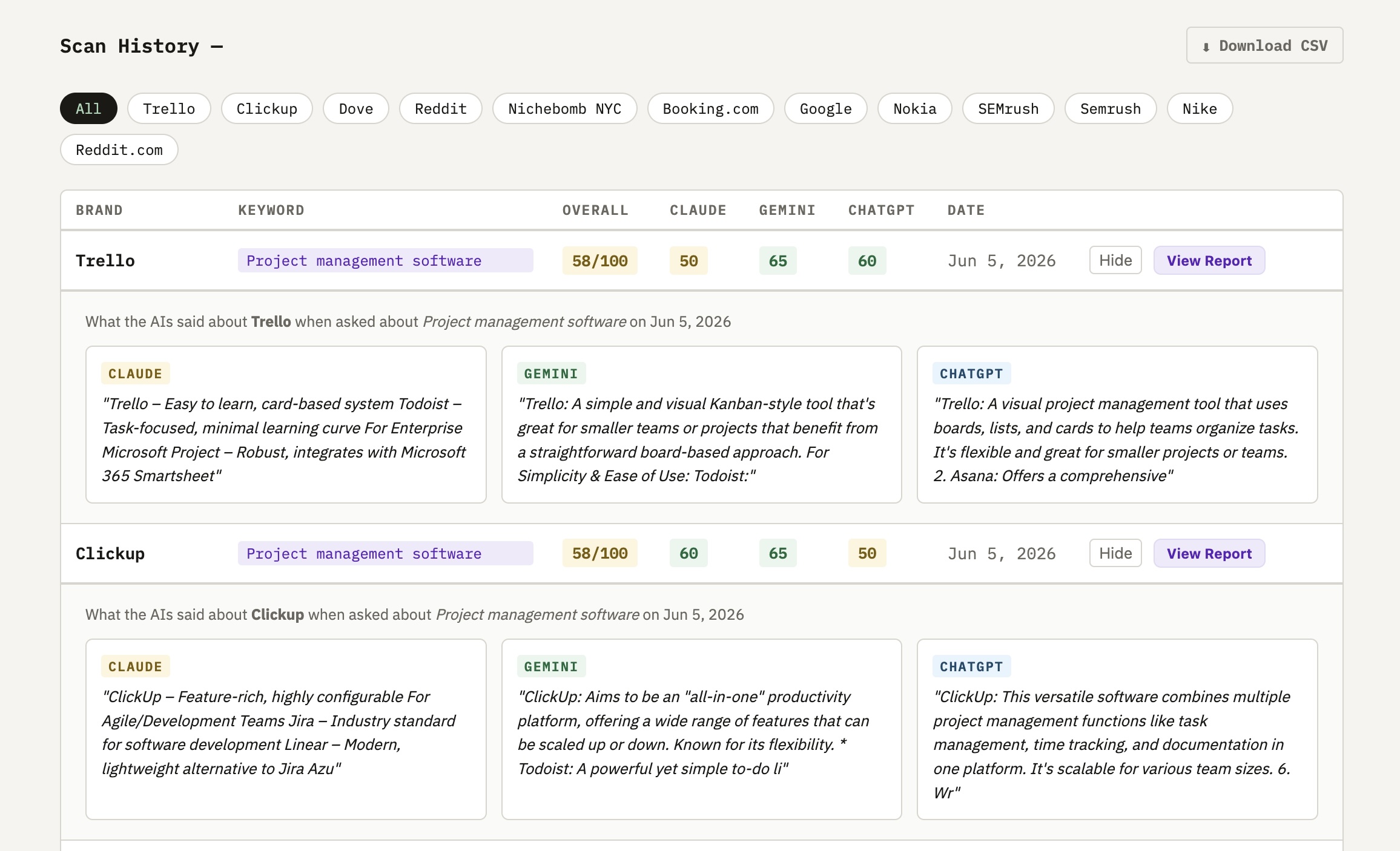
Your scan history shows both brands side by side — scores, excerpts and dates — so you can see the gap clearly and track whether it's narrowing over time. Export everything as CSV for reporting or client presentations.
The Uncomfortable Truth
If your competitor is consistently recommended by AI and you're not, they've almost certainly done work you haven't done yet. They've claimed and optimised their review profiles. They've built the third-party citations. They've published the structured content. They've maintained consistent category positioning across every source AI might find them in.
That's not a criticism — most brands discover this gap after the fact, not before. But it does mean the fix is real work, not a technical trick.
The brands that close the gap do it systematically: audit first, fix the highest-leverage gaps, monitor monthly, and repeat. There's no shortcut, but there is a clear path.
See how your brand compares to competitors in AI search
Free check across ChatGPT, Claude and Gemini — takes 60 seconds, no account needed.
Check your brand free →Frequently Asked Questions
Why does ChatGPT recommend my competitor and not me?
Most likely because your competitor has stronger third-party citation coverage — more reviews on G2 and Capterra, more mentions in industry publications, more consistent category positioning across the sources AI models draw on. It's not a judgment about product quality. It's a reflection of the information landscape AI was trained on.
Can I get AI to stop recommending my competitor?
You can't directly influence what AI says about competitors. What you can do is build your own visibility to the point where you appear alongside them — or ahead of them — in AI-generated answers. The goal isn't to suppress competitors; it's to make your own brand impossible to leave out.
How long will it take to close the gap?
It depends on the size of the gap and the consistency of your action. Smaller gaps generally respond faster to focused work on review platforms, structured content and third-party citations. Larger gaps take more sustained effort. Knowing the size of your gap — which a check on aeogeoai.net gives you — helps you set realistic expectations and prioritise the right actions.
Does paying for ads help with AI visibility?
No. AI models don't know which brands advertise and which don't. Paid search and AI visibility are completely separate channels. The only thing that improves AI visibility is the quality and consistency of organic third-party information about your brand.
Should I check all three AI models or just ChatGPT?
All three. ChatGPT, Claude and Gemini are trained on different data and weight sources differently. A competitor may dominate on ChatGPT while you score comparably on Gemini. Checking all three gives you a complete picture of the competitive landscape in AI search — and tells you where to focus first.