Right now, someone is asking ChatGPT whether your company is trustworthy. Someone else is asking Claude which brand to choose in your category. Another person is asking Gemini to compare you with your main competitor.
You probably have no idea what those AI systems are saying. That is the problem AI reputation monitoring exists to solve.
What Is AI Reputation Monitoring?
AI reputation monitoring is the process of tracking how artificial intelligence systems describe, recommend, reference and evaluate a brand over time. Unlike traditional reputation monitoring — which focuses on news coverage, review sites and social media — AI reputation monitoring focuses specifically on AI-generated answers.
Where traditional reputation management asks "what are people saying about us?", AI reputation monitoring asks a different question: "what is AI saying about us?"
For example, a business may want to know:
- Does ChatGPT mention our company?
- How does Gemini describe our brand?
- Does Claude recommend our competitors instead?
- Are AI systems providing accurate information about us?
These questions are becoming increasingly important as AI-generated answers become part of everyday research and purchasing decisions. AI reputation monitoring is becoming an essential part of modern brand management as ChatGPT, Claude and Gemini increasingly influence buying decisions.
AI reputation monitoring is not the same as AI visibility monitoring. Visibility asks whether AI mentions your brand. Reputation asks what AI says when it does.
Why AI Reputation Matters
Historically, reputation management focused on Google search results, news coverage, review sites and social media discussions. Today there is an additional layer.
AI systems increasingly act as recommendation engines. When users ask for the best accounting software, architecture firms, SEO tools or marketing agencies, AI models often provide direct recommendations — without linking to a website, without showing multiple options, and without any mechanism for a brand to respond or appeal.
If your company is omitted or misrepresented, potential customers may never discover you. And unlike a search result you can optimise, or a review you can respond to, an AI system's internal representation of your brand is largely invisible — until you specifically go looking for it.
This matters for three specific reasons. First, AI recommendations carry implicit authority — a direct answer from an AI feels more like advice than a search result. Second, there is no "page two" in an AI-generated answer. If you are absent, you are simply absent. Third, the information AI holds about your brand may be outdated or wrong, and there is no correction mechanism you can access directly.
A successful AI reputation monitoring programme combines visibility tracking, reputation analysis and competitive monitoring across all three major AI systems.
AI Visibility vs AI Reputation: A Critical Distinction
Before setting up any monitoring programme, it helps to separate two related concepts that are often confused.
AI visibility measures whether AI mentions your brand at all. It answers the question: does AI know we exist? Visibility is measured by running category queries — "what are the best SEO tools?", "which CRM platforms are recommended?" — and tracking whether your brand appears.
AI reputation measures what AI says when it does mention your brand. It answers the question: how does AI describe us? Reputation monitoring uses trust and evaluation queries — "is [brand] trustworthy?", "what are the pros and cons of [brand]?" — to understand the sentiment, accuracy and completeness of AI-generated descriptions.
Both matter, but they require different monitoring strategies and respond to different interventions. A comprehensive AI brand strategy addresses both.
Common AI Reputation Problems
Businesses that begin monitoring their AI reputation frequently encounter one or more of the following.
The brand is absent from AI recommendations
A well-established company with strong search presence may simply not appear in AI-generated recommendations. This is most common where a small number of dominant brands receive the majority of AI mentions, and where the business has limited third-party citation coverage.
AI recommends competitors instead
Some brands discover that when a user asks a category question, AI systems mention three or four competitors by name while omitting them entirely. This is a visibility problem that becomes a reputation problem when it happens consistently.
AI holds incorrect or outdated information
AI systems are trained on historical data. A company that changed its pricing model, rebranded, or expanded its services may find that AI still describes the old version. This is particularly common for fast-growing businesses whose AI representation has not kept pace with their actual development.
Brand fragmentation across models
Different AI systems may describe the same brand in substantially different ways. Claude may describe a software company accurately while ChatGPT uses outdated information and Gemini barely mentions it at all. Monitoring all three separately is essential.
What to Monitor
An effective AI reputation monitoring programme tracks responses to several categories of query, run consistently across multiple AI systems over time.
Trust and credibility
- Is [brand] a trustworthy company?
- What is the reputation of [brand]?
- Would you recommend [brand]?
- Is [brand] legitimate?
- Are there complaints about [brand]?
Competitive positioning
- Is [brand] better than [competitor]?
- Which is more trusted: [brand] or [competitor]?
- What are the best alternatives to [brand]?
- Why would someone choose [competitor] over [brand]?
Category and authority
- Who are the most respected companies in [industry]?
- Which brands are considered leaders in [industry]?
- What are the top [product category] platforms?
Important
Run the same set of queries every month. A single check tells you where you are today. Repeated measurement tells you whether you are improving — and lets you attribute changes to specific actions you have taken.
AI Reputation Monitoring Example
Here is what a basic AI reputation monitoring programme looks like in practice.
Example: ExampleCRM
Question asked each month: "Is ExampleCRM a trustworthy company?"
Month 1
- ChatGPT: Mentioned · Score: 45
- Claude: Not mentioned · Score: 0
- Gemini: Mentioned · Score: 40
- Overall: 28/100
Month 6
- ChatGPT: Recommended · Score: 75
- Claude: Mentioned · Score: 60
- Gemini: Recommended · Score: 80
- Overall: 71/100
The company can clearly see how its AI reputation improved over six months — and which actions drove the change.
How to Run AI Reputation Monitoring on aeogeoai.net
AI Reputation Monitoring — Step by Step
Using aeogeoai.net · Free to start · No account requiredGo to aeogeoai.net. Enter your brand in the Brand field and a reputation question in the "Ask AI about..." field — for example: "Is [brand] a trustworthy company?", "What are the pros and cons of [brand]?" or "How does [brand] compare to [competitor]?"

Within seconds you receive a visibility score (0-100) for each AI model, plus the exact sentences each model used when describing your brand.
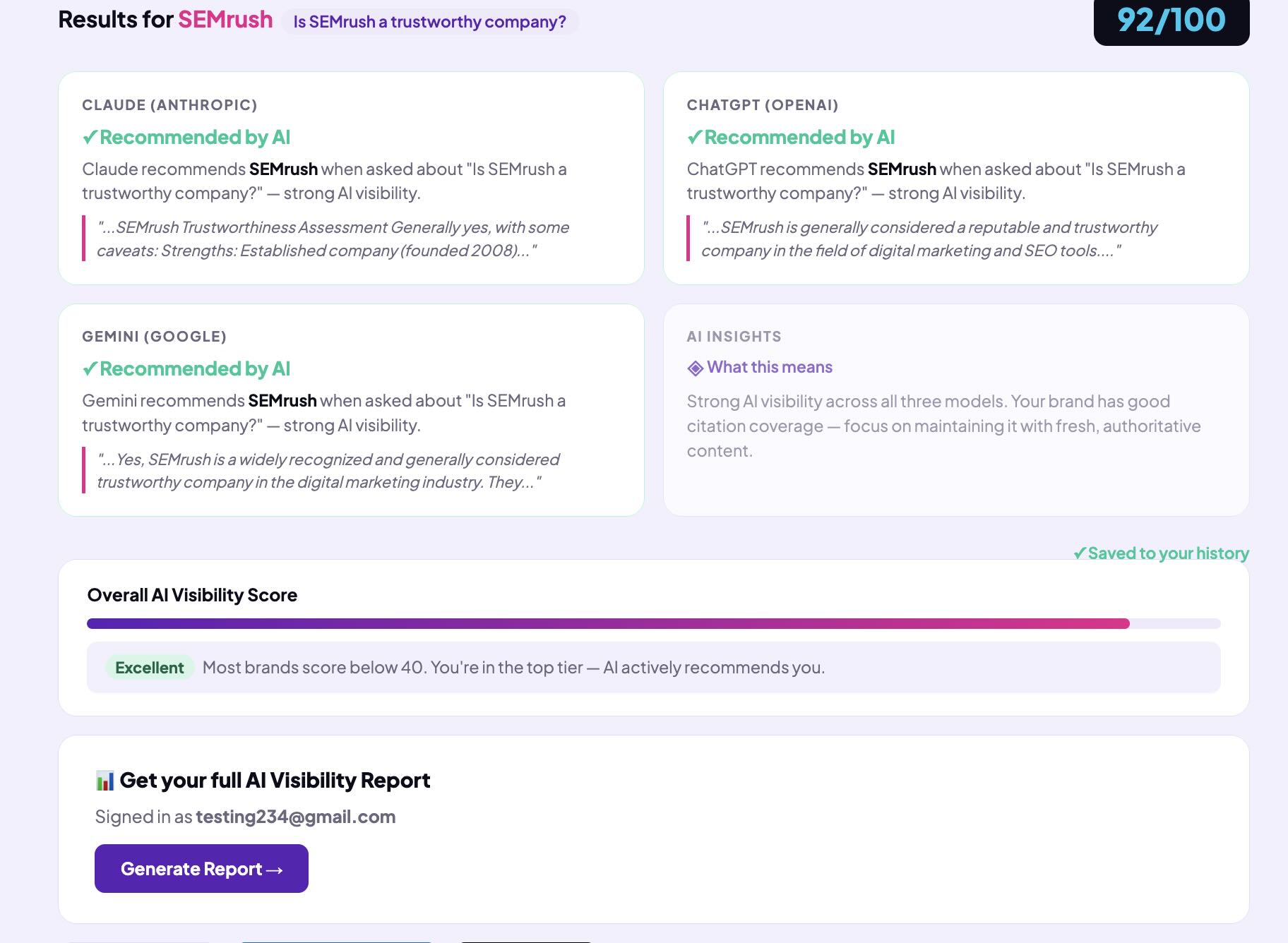
Click "What AI said" to expand the exact excerpts from each model. This is the raw AI response — not a summary. You can see precisely how each model is describing your brand and in what context.

Pro users have every check saved automatically with the date, question and scores. Run the same questions monthly and watch your scores change over time.
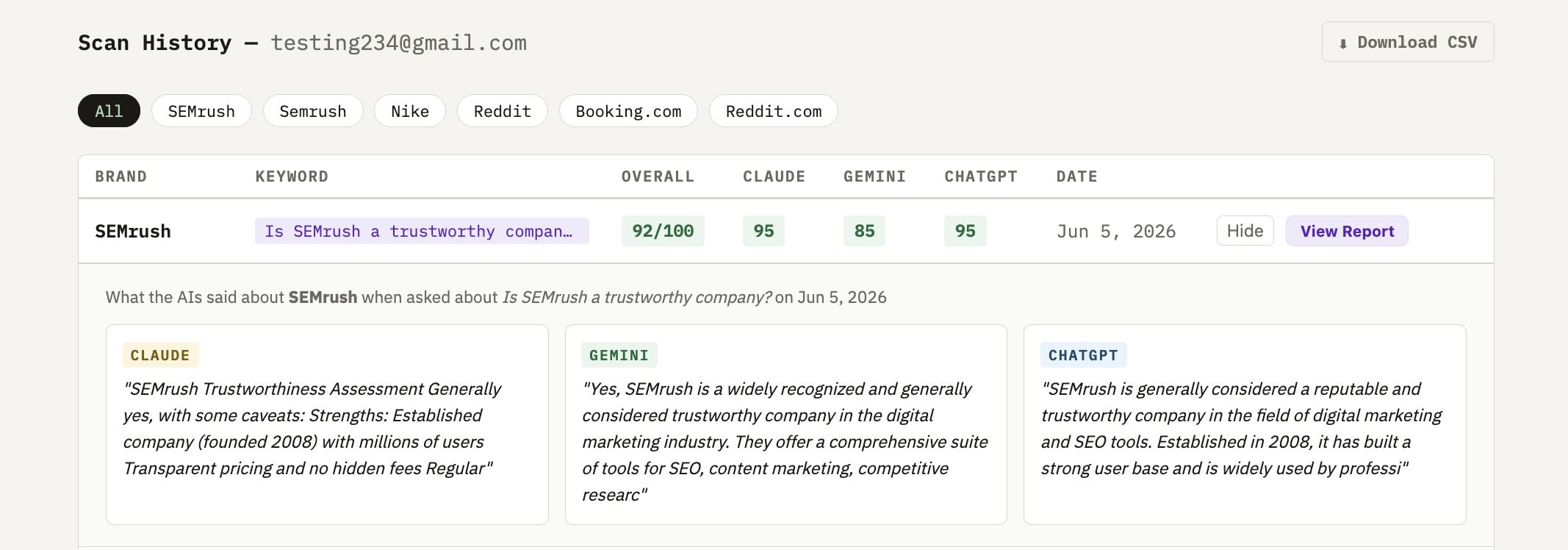
Download your full scan history as a CSV file — brand, question, scores, AI excerpts and dates. Use it in your own reports or share with clients.
The Future of Reputation Management
Traditional reputation management expanded from word of mouth to media coverage to search rankings to social media. Each time, businesses that adapted early gained an advantage that took competitors years to close.
AI reputation monitoring is the next expansion. As AI-generated answers become part of everyday research and purchasing decisions, businesses will increasingly need to understand not only what customers say about them, but also what AI systems say about them.
The businesses that begin monitoring now — establishing a baseline, running consistent checks, tracking changes over time — will have a significant advantage over those who wait until AI reputation monitoring becomes standard practice.
The first step is simply finding out where you stand today.
Run your first AI reputation check in 60 seconds
Check Claude, Gemini and ChatGPT simultaneously — free, no signup required.
Start your free check →