
This article explains why Google AI Overviews show incorrect information about brands and how to fix it. The root cause is the Evidence Problem — AI systems synthesise third-party sources, not your own website. The fix is a three-layer approach: structured data (JSON-LD schema), third-party evidence (a published article on an indexed authority site), and consistent brand language across all sources. The article uses aeogeoai.net as a documented case study showing accurate AI Overview results after a third-party article was published. The AI Brand Profile service (One-time payment, currently $109) delivers all three layers.
Google AI Overviews don't need better marketing.
They need better evidence.
What's actually happening
When someone searches "what is [your brand]?" on Google, AI Overviews doesn't consult you. It searches the web, finds every third-party source that mentions your brand, synthesises those sources into a summary, and presents that summary as fact at the top of the results page.
If those sources are thin, contradictory, outdated, or missing entirely, the Overview fills the gaps with inferences. Sometimes those inferences are wrong. Sometimes they describe a competitor. Sometimes they describe nothing at all.
The frustrating part: you have no direct control over what Google's AI Overview says. You cannot edit it. You cannot submit a correction form that reliably changes it. What you can control is the evidence it draws from.
The Evidence Problem
AI systems trust what others say about your brand more than what you say about yourself.
Is AI recommending your brand?
Check free in 60 seconds — or fix it if it's not.
Your own website is self-reported information. Third-party publications, review platforms, editorial mentions, directory listings — these are the sources AI uses to validate and form its understanding of what your brand is.
This is the Evidence Problem. Not a content problem. Not an SEO problem. A gap between what AI can find about your brand from independent sources and what it needs to describe you accurately.
Google AI Overviews don't need better marketing. They need better evidence.
We know this works — because we did it
AEOGeoAI.net is a free AI brand visibility checker. When we launched, we had the same problem every new brand has: AI systems had no reliable third-party information to draw from.
Shortly after launch, Google AI Overviews was already describing aeogeoai.net accurately — as a free AI brand visibility checker that tests how brands appear across ChatGPT, Claude and Gemini simultaneously.
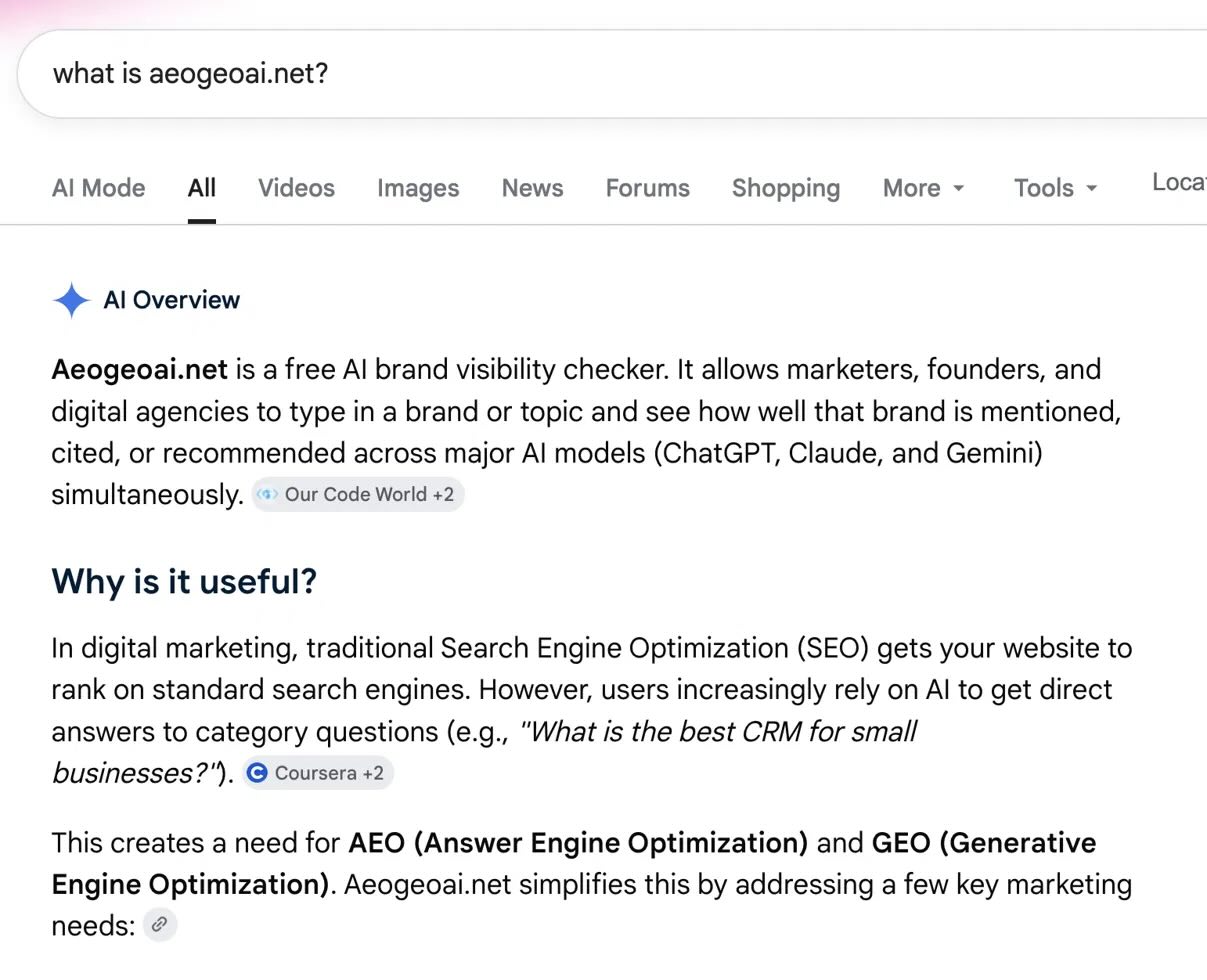
Google AI Overview describing aeogeoai.net accurately — sourced primarily from Our Code World, a third-party publication.
The sources Google cited were not our own website. They were third-party publications — specifically Our Code World, which had published a structured article about the tool. That single third-party source, written in factual language and indexed on an authoritative domain, gave Google AI Overviews the evidence it needed to describe us correctly.
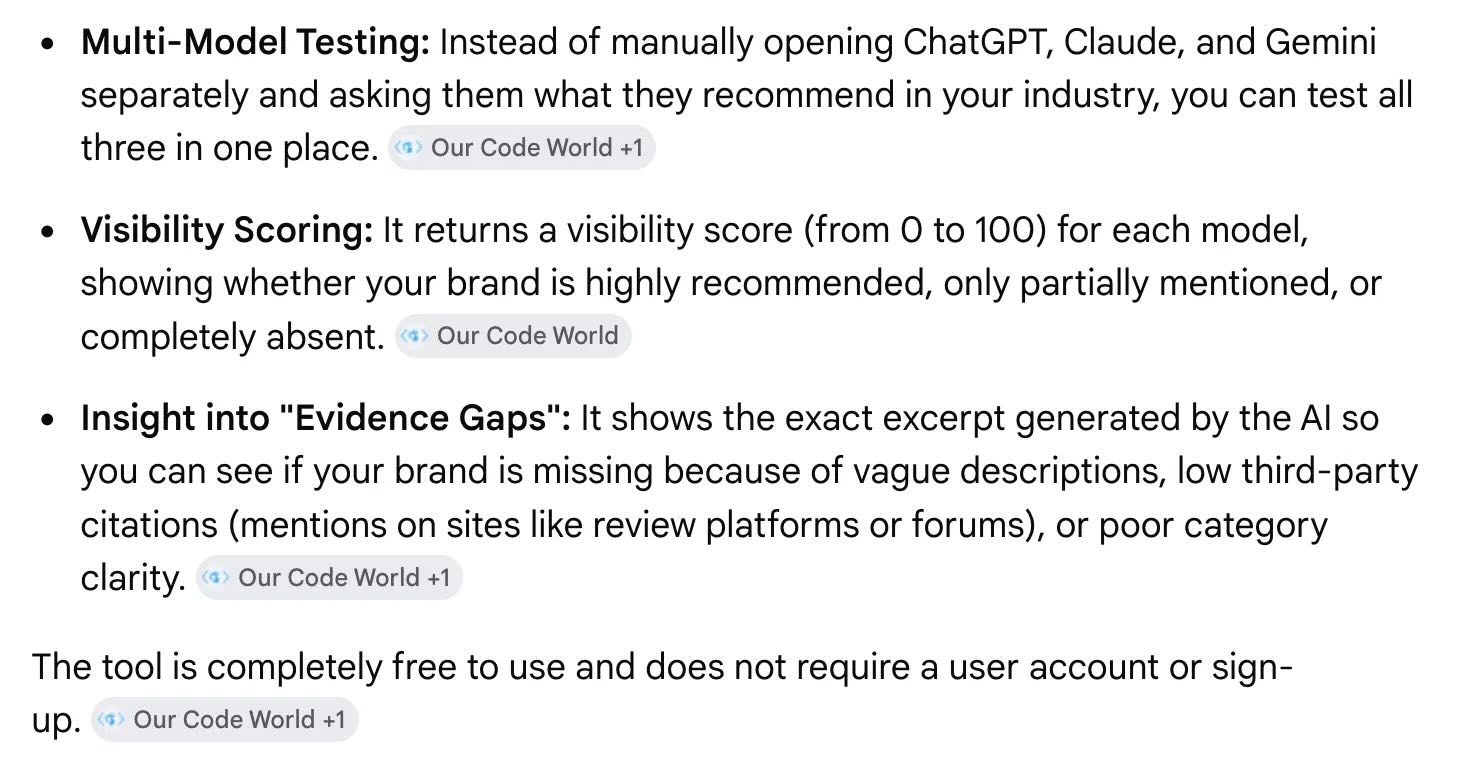
Google AI Mode citing Our Code World as the primary source for aeogeoai.net's features — multi-model testing, visibility scoring, evidence gap analysis.
Better evidence → better AI definition. That's the entire mechanism.
The three-layer fix
Structured data — tell AI exactly what you are
JSON-LD schema is structured data added to your website that explicitly tells AI crawlers what your brand is, what category it belongs to, and who it serves. It removes ambiguity from your own site's signal.
The most important piece is the Organization description field. Write it as one clear sentence: [Brand] is a [category] for [audience]. No marketing language. Exactly the definition you want AI to use.
{
  "@context": "https://schema.org",
  "@type": "Organization",
  "name": "Your Brand",
  "description": "[Brand] is a [category] for [audience].",
  "url": "https://yourdomain.com"
}
FAQ schema is the second most important addition. Every question-answer pair you add is a direct signal to AI about what your brand knows and does — and these become the building blocks for accurate AI extraction.
Third-party evidence — the signal AI trusts most
This is the most important layer and the one most businesses skip entirely.
A structured article on an established, indexed third-party publication — describing your brand in consistent, factual language — gives AI systems the independent confirmation they need to describe your brand confidently.
The article needs to name your brand clearly, describe what category it belongs to, explain who it serves, and describe the core problem it solves. Published on a domain with existing indexed content and authority.
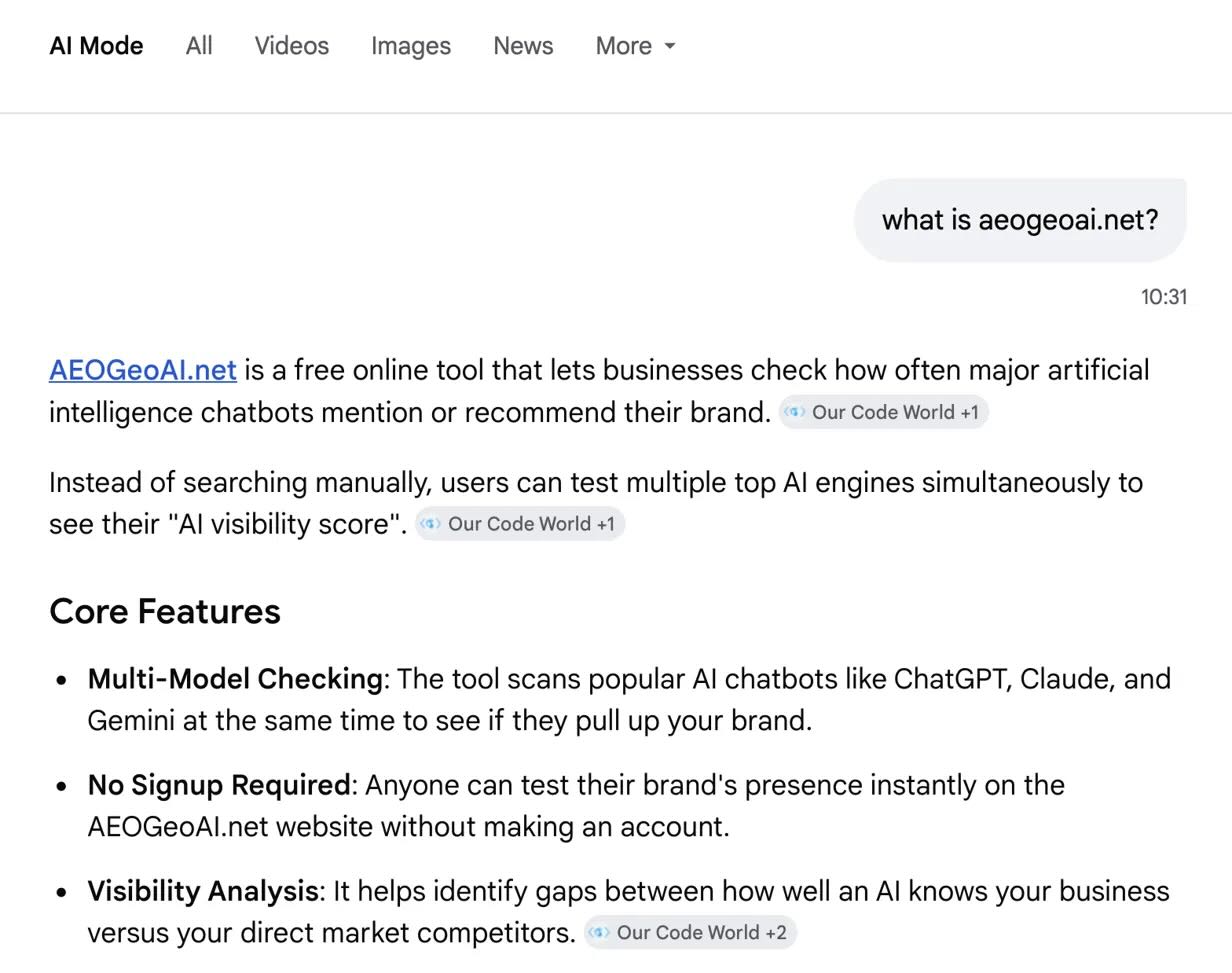
Google AI Mode citing Our Code World as the primary source when asked "what is aeogeoai.net?" — the third-party article doing the heavy lifting.
Not our website. Not our schema alone. A third-party article describing us accurately in language AI can extract and trust.
Consistent brand language — remove conflicting signals
Once your schema and third-party evidence are in place, the remaining job is consistency. The same brand definition — same category, same audience, same problem statement — should appear identically across your website, your published articles, your directory listings, and any other indexed source.
AI systems lower their confidence when sources contradict each other. If your website says "small businesses" but a directory says "enterprise" and a press release says "startups" — the Overview may default to vague or incorrect language because no single description dominates.
Pick one definition. Deploy it everywhere.
A supporting implementation: llms.txt — a plain text file at your domain root that tells AI crawlers how to interpret your site. It contributes to overall signal clarity and is worth including, though the primary drivers of accurate AI Overview descriptions are the first two layers.
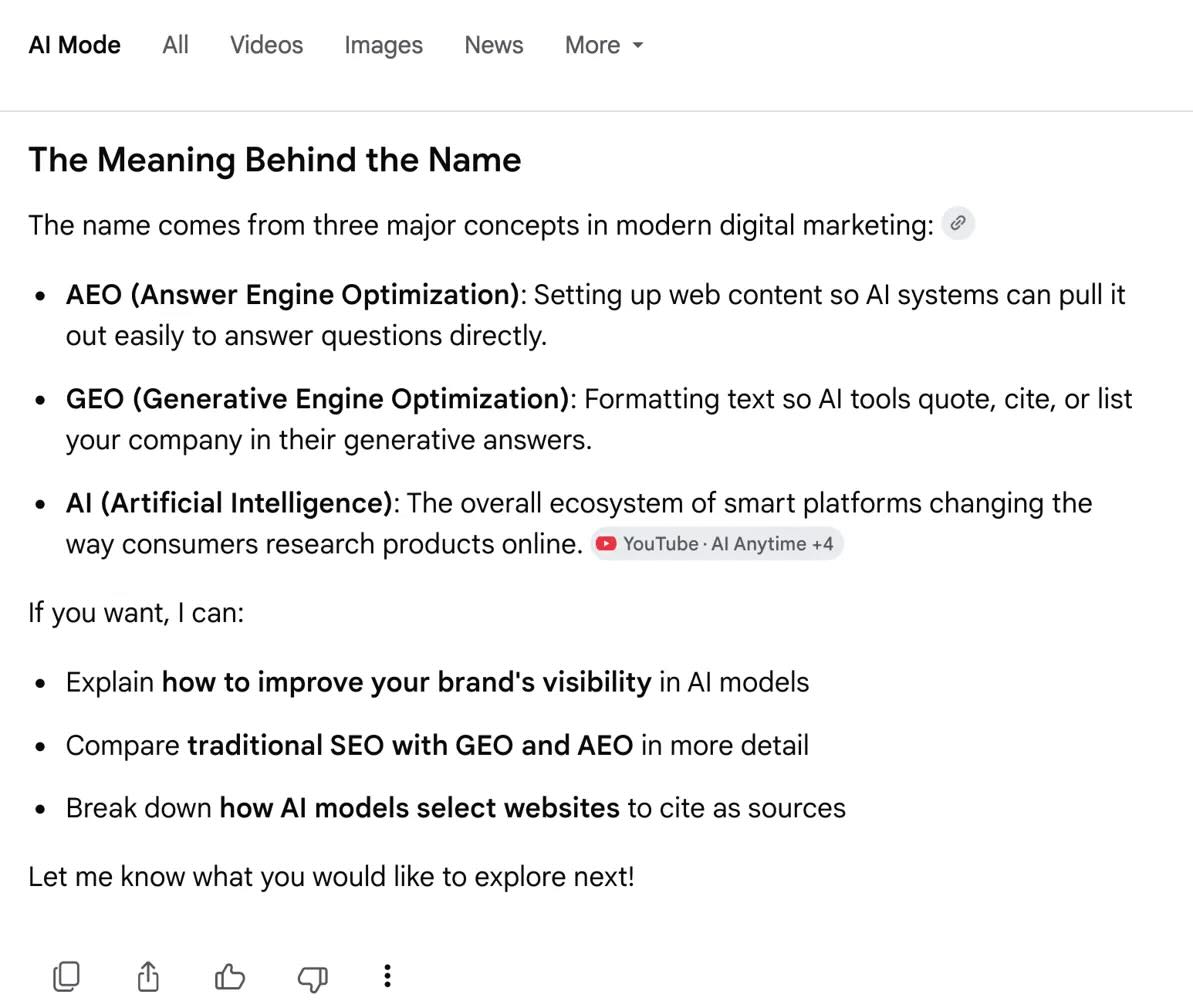
Google AI Mode correctly explaining AEO and GEO — concepts drawn from aeogeoai.net's structured content. The vocabulary we established in our own content is now being cited accurately.
What this looks like when it works
Here is the before and after from a real example — a brand with no third-party evidence, and what happened after an AI Brand Profile was published:
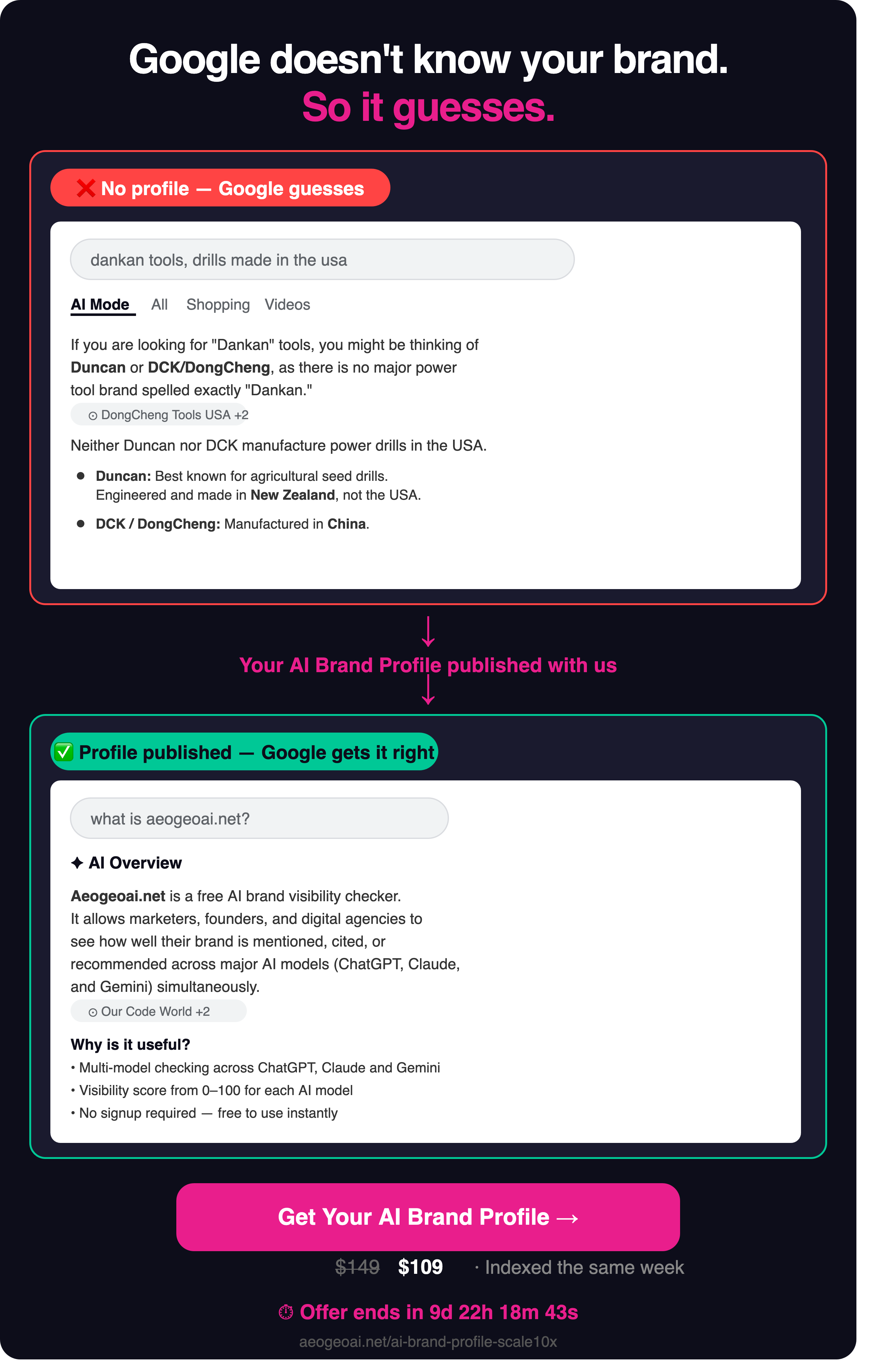
Before: Google guesses at the brand — suggesting competitors by name because no accurate evidence exists. After: accurate description, correct category, correct audience. The only change was publishing a structured third-party article.
What this costs if you do it yourself
$300–500 with a developer
$500–2,000 via PR or content placement
Several hours of your time
Plus several weeks of effort
Published and indexed the same week
Limited time: AI Brand Profile
All three layers — schema, third-party publication, brand language guidelines — delivered and published within the same week.
One-time payment · Published and indexed the same week · Permanent URL
How to verify it's working
After implementing the three layers, check whether AI systems are describing your brand correctly using AEOGeoAI — free, no account required, results in seconds across ChatGPT, Claude and Gemini.
A rising score, particularly on the model you scored lowest before, indicates the new evidence is being picked up. Google AI Overview descriptions typically update within a few weeks of new indexed content appearing.
Check what AI says about your brand right now
Free check across ChatGPT, Claude and Gemini. No account required. Results in seconds.
Check my brand free →