Every day, millions of people ask ChatGPT questions about brands, companies and products. They ask whether a business is trustworthy. They ask which tools are worth paying for. They ask how one company compares to another.
ChatGPT answers those questions directly — no links, no options, no "it depends." It picks a position and states it as fact.
The question is: what position is it taking on your brand?
Why What ChatGPT Says About Your Brand Matters
Until recently, a brand's online reputation lived in search results, review sites and social media. You could monitor all of those. You could respond to negative reviews. You could optimise your search presence. The channels were visible and, to some degree, controllable.
ChatGPT changed that. When a user asks ChatGPT about your brand, they receive a direct answer generated from training data. There is no review to respond to. There is no ranking to optimise in the traditional sense. There is no notification when someone asks about you.
And yet that answer — whatever it says — may be influencing how potential customers perceive your brand before they ever visit your website.
ChatGPT has over 2.5 billion daily prompts. A significant proportion of those are brand and product research questions. Most brands have no idea what ChatGPT is saying about them.
Most businesses monitor their Google rankings monthly. Very few monitor what AI systems are saying about them. That gap is where reputation problems go undetected.
What ChatGPT Typically Says About Brands
When asked about a brand, ChatGPT tends to draw on a combination of sources: its training data, which includes web content, reviews, news coverage and discussion forums up to its knowledge cutoff. The result is a synthesis — not a quote from any single source, but a composite picture assembled from everything the model has absorbed about that brand.
For well-known brands with strong citation coverage, ChatGPT usually produces accurate, reasonably positive descriptions. For smaller or newer brands, the results are less predictable. The model may:
- Describe an older version of the business that no longer reflects reality
- Conflate the brand with a similarly named competitor
- Produce a vague, non-committal description that neither recommends nor dismisses
- Simply say it doesn't have enough information — which is itself a form of low visibility
- Mention competitors prominently while barely acknowledging your brand
The only way to know which of these applies to your brand is to ask.
The Questions That Reveal the Most
Not all questions produce equally useful answers. The most revealing questions for understanding what ChatGPT says about your brand fall into a few categories.
Trust and recommendation questions
These produce the most direct signal about how ChatGPT positions your brand:
- Is [brand] a trustworthy company?
- Would you recommend [brand]?
- Is [brand] legitimate?
- What are the pros and cons of [brand]?
Category and competitive questions
These reveal whether ChatGPT includes your brand when recommending options in your category:
- What are the best [product category] tools?
- Which [industry] companies do you recommend?
- How does [brand] compare to [competitor]?
Knowledge and accuracy questions
These test whether the information ChatGPT holds about your brand is current and correct:
- What does [brand] do?
- Who is [brand] best for?
- What is [brand] known for?
Competitor perception questions
These reveal how ChatGPT positions your brand relative to competitors — often the most eye-opening results:
- Is [brand] better than [competitor]?
- Which is more trusted: [brand] or [competitor]?
- What are the best alternatives to [brand]?
- Why would someone choose [competitor] over [brand]?
Important
Ask the same question across ChatGPT, Claude and Gemini. What ChatGPT says about your brand is often significantly different from what Gemini or Claude say — because each model draws on different training data and weights sources differently.
What ChatGPT Said About SEMrush
To show what this looks like in practice, here is a real example using SEMrush — one of the most recognised brands in SEO.
Question asked: "Is SEMrush a trustworthy company?"
Results across all three models:
- Claude: "SEMrush Trustworthiness Assessment — Generally yes, with some caveats. Strengths: Established company (founded 2008) with millions of users, transparent pricing and no hidden fees..."
- Gemini: "Yes, SEMrush is a widely recognised and generally considered trustworthy company in the digital marketing industry..."
- ChatGPT: "SEMrush is generally considered a reputable and trustworthy company in the field of digital marketing and SEO tools. Established in 2008, it has built a strong user base..."
Overall score: 92/100. All three models recommended the brand confidently. For a brand with SEMrush's profile this is expected — but the same test on a lesser-known brand often produces dramatically different results across the three models.
How to Find Out What ChatGPT Says About Your Brand
Check what ChatGPT says about your brand
Using aeogeoai.net · Free · No account requiredGo to aeogeoai.net. Type your brand name and a question in the "Ask AI about..." field — for example: "Is [brand] a trustworthy company?" or "What are the pros and cons of [brand]?"

Within seconds you get a score (0-100) for each model plus the exact sentences each AI used to describe your brand. You can see whether ChatGPT recommends you, mentions you in passing, or ignores you entirely.
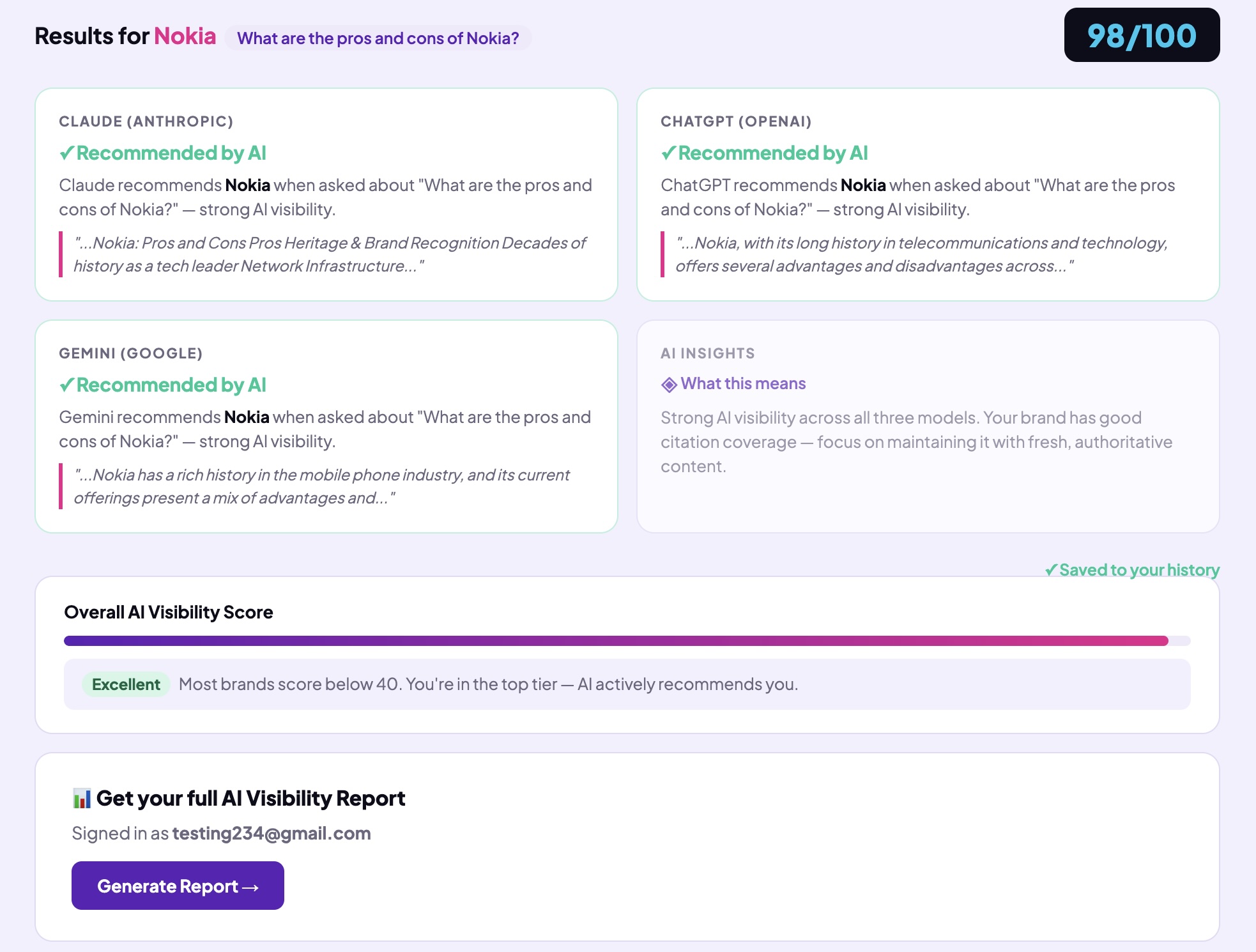
Click "What AI said" to see the full excerpt from each model — the actual words ChatGPT used, not a summary. This tells you exactly how your brand is being described to users who ask about you.
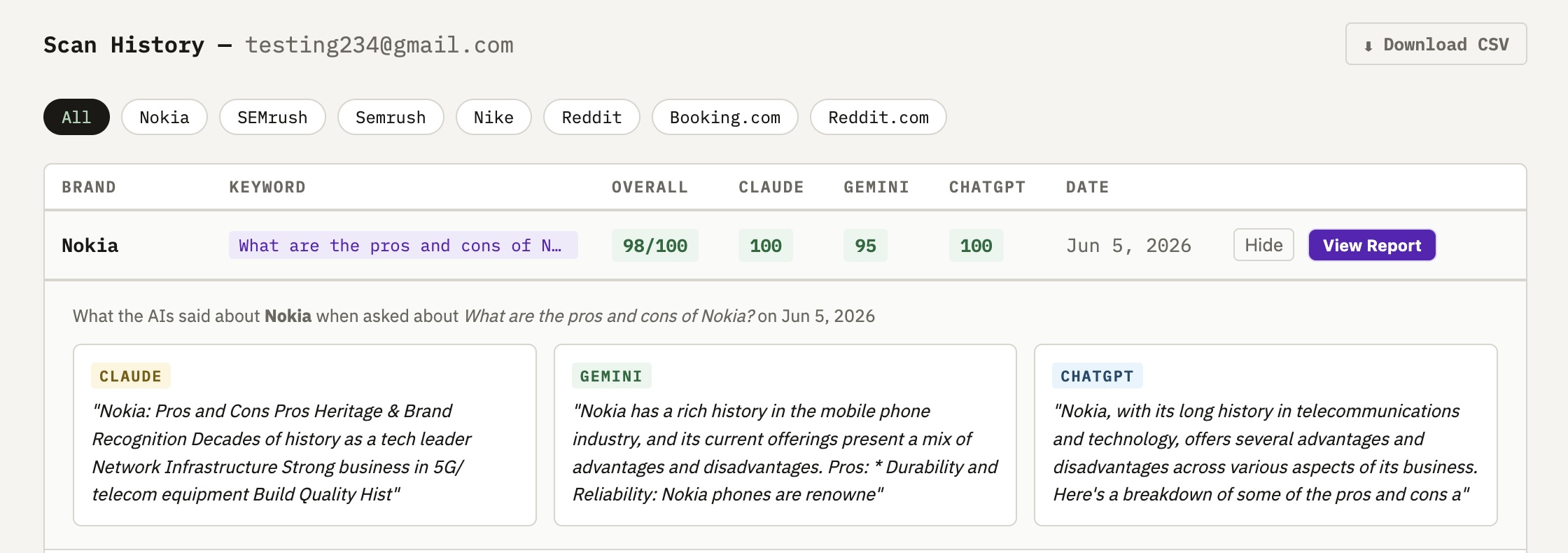
Pro users have every check saved automatically with the date, brand, question and scores. Run the same question monthly and watch whether ChatGPT's description improves over time. Free users can note their score manually and re-check whenever they want.
Download every scan, question, score and AI excerpt as a CSV file. Track changes over time in your own spreadsheet or share AI reputation reports with clients.

What to Do If You Don't Like What ChatGPT Says
There is no direct mechanism to correct ChatGPT. You cannot submit an edit or flag incorrect information the way you might on Wikipedia. However, you can influence what future versions of the model learn about your brand by shaping the information landscape it draws on.
The most effective approaches are:
- Third-party citations — getting your brand mentioned accurately on high-authority sites that AI models weight heavily: industry publications, G2, Trustpilot, Reddit, Wikipedia where applicable
- Structured content — publishing clear, direct answers to the questions you want AI to get right, with FAQ schema markup so the answers are easily extractable
- Consistent entity definition — ensuring your brand name, description, category and key facts are consistent across all the places AI might find information about you
- Regular monitoring — running the same questions monthly to detect when ChatGPT's description changes, and understanding which actions drove the improvement
This process — monitoring what ChatGPT says about your brand and systematically working to improve it — is what AI reputation monitoring means in practice. For a fuller overview of the discipline, see our guide to AI reputation monitoring.
Find out what ChatGPT says about your brand in 60 seconds
Free check across ChatGPT, Claude and Gemini — no signup required.
Check your brand free →Frequently Asked Questions
What does ChatGPT say about my brand?
It depends on your brand's visibility in ChatGPT's training data. Well-known brands with strong third-party citation coverage tend to be described accurately and positively. Smaller or newer brands may be described vaguely, incorrectly, or not mentioned at all. The only way to find out is to ask — which you can do for free at aeogeoai.net.
Does ChatGPT say different things about the same brand at different times?
Yes — ChatGPT uses a temperature setting that introduces some variation in responses. The core description tends to be consistent, but phrasing and emphasis can vary between queries. Running multiple checks and averaging the results gives a more reliable picture than a single query.
Is what ChatGPT says about my brand the same as what Google says?
No — they are fundamentally different. Google returns links to sources that describe your brand. ChatGPT generates its own description based on what it learned during training. A brand can rank well on Google while being poorly represented in ChatGPT, and vice versa.
Can I check what Claude and Gemini say as well as ChatGPT?
Yes — aeogeoai.net checks all three simultaneously. This is important because each model draws on different training data and may describe your brand very differently. A brand that ChatGPT recommends confidently may score much lower on Gemini.
How do I improve what ChatGPT says about my brand?
Focus on building authoritative third-party mentions — on review platforms, industry publications, forums and structured directories. ChatGPT weights these sources heavily. Publishing structured FAQ content on your own site and ensuring consistent brand descriptions across all platforms also helps over time.