If you sell software, the question used to be: do you rank on Google?
Now there's a second question that matters just as much: does AI recommend you?
Every day, founders, marketers and buyers ask ChatGPT, Claude and Gemini things like "what's the best CRM for a small team?" or "which project management tool would you recommend?" or "what's a good alternative to [competitor]?" The model answers. It names tools. It recommends some and ignores others.
If your SaaS product isn't being named in those answers, you're missing buyers who never reached your website — because the AI gave them an answer and they stopped looking.
Why SaaS Brands Are Uniquely Affected
AI recommendation visibility matters for every type of brand — but SaaS products are in a particularly exposed position. Software recommendations are one of the most common AI search behaviours. People routinely ask:
Common AI software queries
- Which CRM should I use for a small team?
- Which SEO tools are best for agencies?
- What's the best project management platform?
- What is a good alternative to HubSpot?
- Which email marketing software would you recommend?
These are exactly the types of questions AI systems answer directly — and they're answered millions of times every day. Three reasons SaaS products are uniquely exposed:
SaaS categories are crowded. In most categories, dozens of tools compete for a small number of AI recommendation slots. The difference between appearing in answers and not appearing is often determined by citation volume and category clarity — not product quality.
Buyers trust AI for software research. Software is a high-consideration purchase. The options are numerous, the differences can be subtle, and buyers actively want someone — or something — to filter the noise. AI recommendations carry significant weight in the shortlisting process.
Training data cutoffs hit SaaS hard. If your product launched in the last 12–18 months, or you've pivoted or rebranded, you may be partially or completely absent from AI training data. AI models can't recommend what they don't know about.
The Three Questions AI Answers About Your SaaS
When a buyer asks AI about software in your category, the model is effectively answering three questions simultaneously:
Does this tool exist and what does it do?
Entity recognition — the foundation. Before AI can recommend your product, it needs to know it exists, understand what category it belongs to, and have a clear description of what it does. If AI has thin, vague or inconsistent information about your product, it won't surface it confidently even when the query is a perfect match.
Is it worth recommending?
Reputation signal. Based on what AI has learned from reviews, comparisons and third-party coverage, does your product have enough positive signal to include in an answer? A product with strong G2 presence, consistent third-party coverage and clear positioning will be recommended ahead of one with sparse or conflicting information — regardless of which is actually better.
For whom?
Audience fit. AI increasingly qualifies recommendations by use case, company size or audience. "Best for small teams", "enterprise-grade", "ideal for freelancers". If AI doesn't know who your product is for, it will recommend you less confidently — or not at all. Clear, consistent audience definition across your website, profiles and coverage is one of the highest-leverage signals you can build.
How to Check if AI Recommends Your SaaS
The fastest way is to ask AI directly — the same way your potential buyers do. Open ChatGPT, Claude or Gemini and ask "What are the best [your category] tools?" or "Which [your category] software would you recommend for [your target audience]?" or "What's a good alternative to [your top competitor]?"
The problem with the manual method is that each model gives different answers, results vary between sessions, and you get no score, no baseline and no way to track change over time.
The systematic method is to use a tool that checks all three models simultaneously, scores each response 0–100, and returns the exact text each model used. This gives you a comparable baseline you can track monthly. For the full picture of what AI is saying about your product — not just whether it mentions you — see our guide to what does ChatGPT say about your brand.
What Your AI Visibility Score Means for SaaS
When you run a check on aeogeoai.net, your SaaS product gets a score from 0–100 per model:
70–100: Strong AI visibility. Your product is being recommended confidently in category answers. AI has clear, consistent information about what you do and who you serve.
40–69: Moderate visibility. AI mentions your product but inconsistently — in some queries but not others, or described vaguely rather than with confidence. The signal is already there to build on.
0–39: Low or zero visibility. AI either doesn't know your product or has too little information to recommend it confidently. Most common for newer tools, rebranded products, or SaaS in crowded categories where established players dominate the training data.
The score gap between you and a competitor is your AI visibility gap. In many SaaS categories, larger gaps may indicate a greater likelihood that buyers encounter competitor recommendations before they encounter yours.
Find out if AI recommends your SaaS product
Free check across ChatGPT, Claude and Gemini — no signup required, results in 60 seconds.
Check your product free →See Your SaaS Through the Eyes of AI
Traffic, conversions, rankings — what happens after someone reaches your site.
Scores, excerpts, category associations — what AI says before buyers reach your site.
How to Check AI Visibility for Your SaaS Product
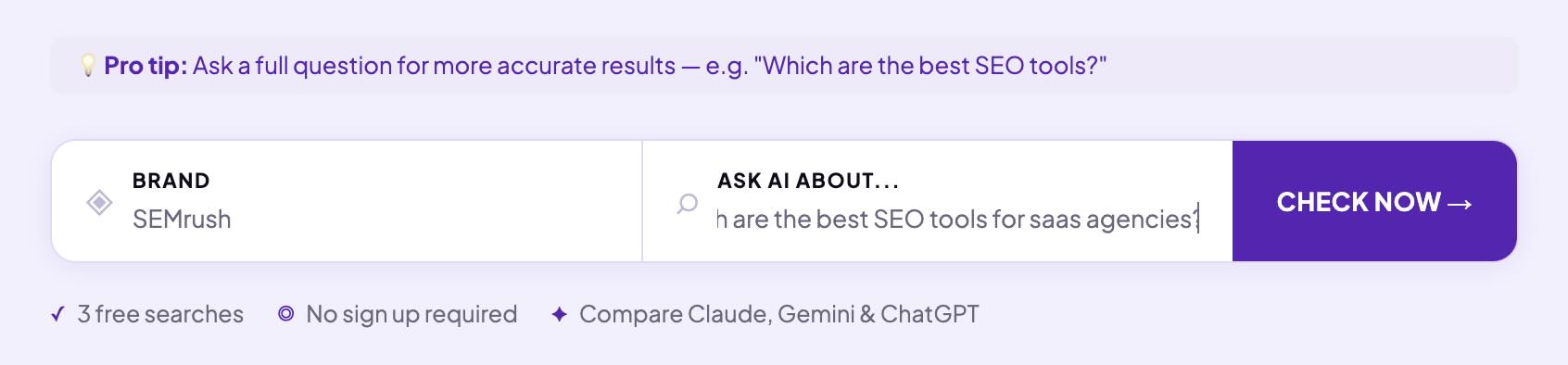
Using aeogeoai.net — free, no account requiredGo to aeogeoai.net, enter your SaaS product name and a question your buyers would ask — for example "Which are the best [your category] tools for [your audience]?"
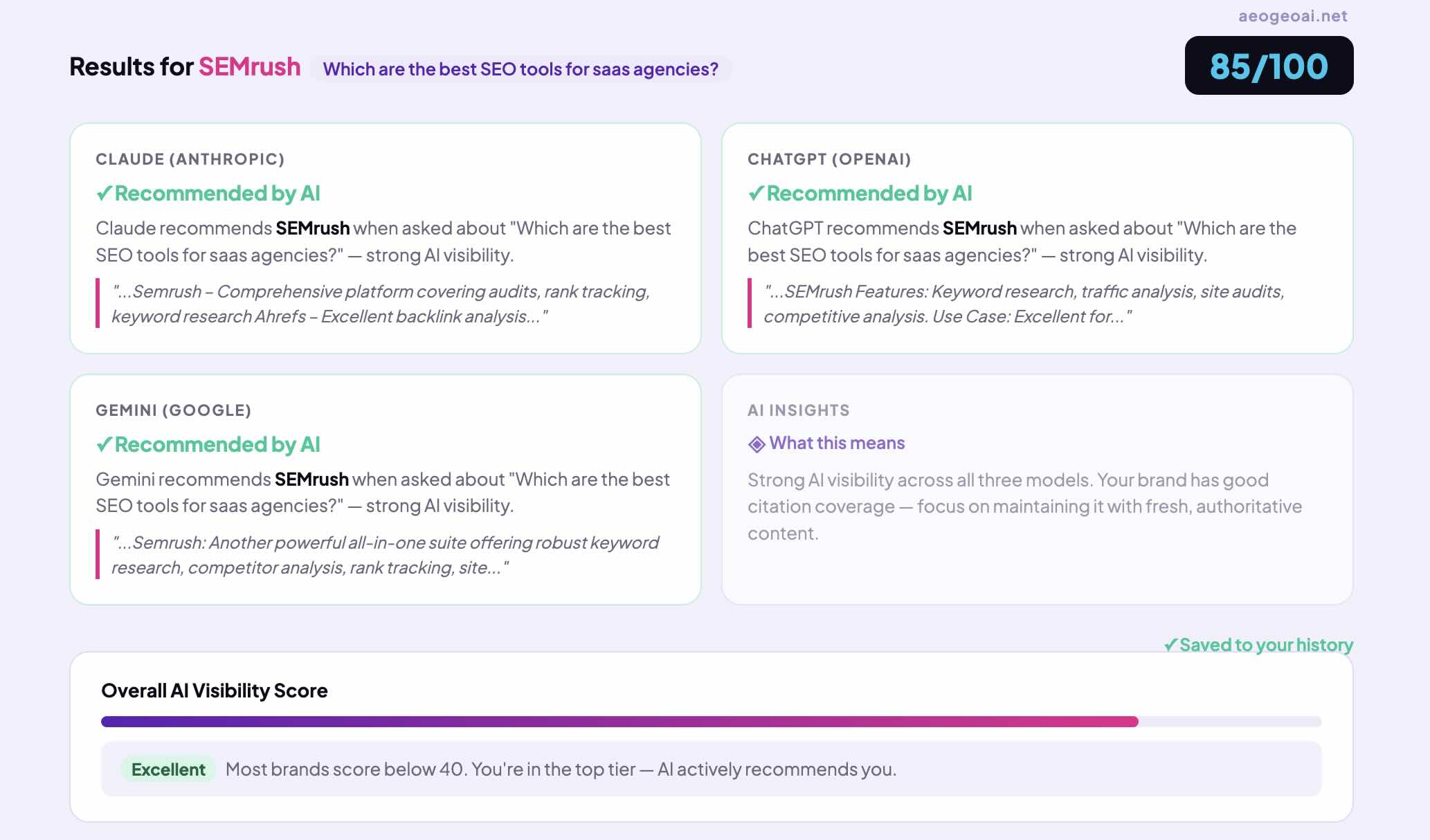
See your visibility score across ChatGPT, Claude and Gemini, plus the exact words each model used to describe your product. Note whether you're "Recommended by AI", "Partially visible" or absent.
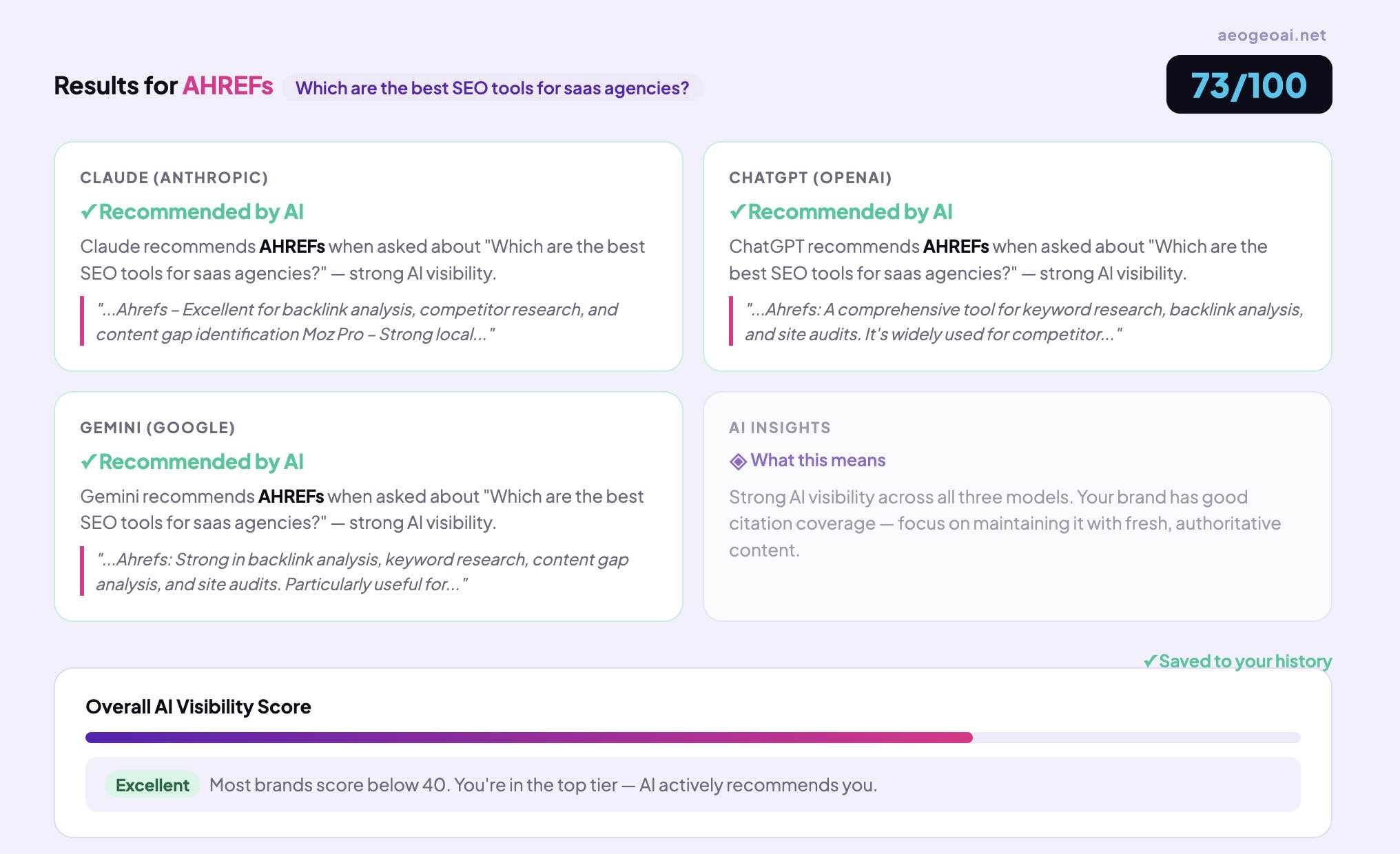
Run the same check for your top two or three competitors. Compare scores. Calculate your AI visibility gap — the number that tells you how far ahead or behind you are in AI-generated answers.
Save every check with date, product and scores. Run the same questions monthly. Export to CSV for reporting and investor updates.
Why AI Might Not Be Recommending Your SaaS
You're not on the review platforms AI weights most. G2, Capterra and Trustpilot are among the highest-signal sources for SaaS AI visibility. If your product isn't listed, or your profile is sparse, AI doesn't have enough third-party evidence to recommend you confidently.
Your category positioning is unclear or inconsistent. AI needs to know what your product does, who it's for, and what problem it solves — stated consistently across multiple sources. If your website says one thing, your G2 profile says another, and your press coverage describes a slightly different product, AI has weak signal.
You're newer than the training data. If your product launched or rebranded after the model's training cutoff, it may simply not exist in the model's knowledge base yet.
Your competitors have stronger citation networks. In most SaaS categories, a handful of established products dominate AI recommendations because they've accumulated years of third-party coverage. That advantage responds to systematic effort — but it takes time.
How to Improve AI Visibility for Your SaaS
Claim and optimise your G2 and Capterra profiles. These are the highest-leverage actions for most SaaS products. Make sure your product description is accurate, current and uses the category language buyers and AI models associate with your space. Actively seek reviews from existing customers.
Publish a clear entity definition. Use the brand definition formula on your website, in your profiles and in any press coverage:
It does [core function].
It solves [specific problem].
This exact description — used consistently across every source — is one of the strongest signals you can give AI models.
Build structured FAQ content. Publish clear answers to the questions buyers ask in your category. Use FAQ schema markup. These make your answers easy for AI models to extract and cite.
Get into comparison and roundup content. "Best [category] tools" articles on authoritative sites are disproportionately cited by AI models. Getting your product included in three or four of these can move your visibility score meaningfully.
Address the alternative queries. "What's a good alternative to [competitor]?" is one of the most valuable AI query patterns for SaaS. If your product isn't appearing in those answers, publish direct comparison content and get included in third-party comparison articles.
For a deeper look at why competitors appear ahead of you and what to do about it, see our guide to why AI recommends competitors. For a complete monthly tracking framework, see our guide to running a monthly AI reputation audit.
Check if AI is recommending your SaaS product today
Free check across ChatGPT, Claude and Gemini — takes 60 seconds, no account needed.
Check your product free →Frequently Asked Questions
Why doesn't AI recommend my SaaS product even though I rank well on Google?
Google rankings and AI visibility are separate channels with different signals. AI models weight third-party citations — review platforms, comparison articles, forum discussions — more heavily than search rankings. A product can rank well on Google while being absent from AI-generated answers. Both matter, but they require different strategies.
How long does it take for AI to start recommending a new SaaS product?
It depends on the model and how quickly you build third-party presence. Retrieval-augmented systems like Perplexity can reflect new content within days to weeks. Training-based models like ChatGPT and Claude update on a schedule — typically every few months — so changes may take time to appear in their outputs. Starting early and building consistently is the most reliable approach.
My product launched recently. Will AI know about it?
Possibly not — especially on ChatGPT and Claude, which have training data cutoffs. If your product is less than 12–18 months old, it may be partially or completely absent from their training data. Perplexity is more likely to have current information. The fix is to build third-party presence now so you're well-represented in the next training cycle.
Which AI model matters most for SaaS visibility?
All three matter, but ChatGPT has the largest user base for software research queries. Gemini matters for Google-integrated search. Claude is increasingly used by technical buyers. Checking all three gives you a complete picture — and the scores often differ significantly, which tells you where to focus first.
Does paid advertising help with AI visibility?
No. AI models don't know which products advertise and don't factor this into recommendations. The only thing that improves AI visibility is the quality and consistency of organic third-party information about your product.