A single AI reputation check tells you where your brand stands today. A monthly AI reputation audit tells you whether you are improving — and what is driving the change.
Most brands that start monitoring their AI reputation make the same mistake: they check once, note the score, and move on. Without consistent measurement, you cannot tell the difference between a real improvement and normal variation in how AI models respond. You cannot attribute progress to specific actions. And you cannot catch problems before they become entrenched.
This guide covers exactly how to set up and run a monthly AI reputation audit — the questions to ask, the cadence to follow, and how to use the results.
AI visibility asks whether AI mentions your brand at all. AI reputation asks what AI says when it does — how it describes you, whether it recommends you, and how it positions you against competitors. A monthly audit tracks both.
A monthly AI reputation audit is the practice of running the same set of questions across ChatGPT, Claude and Gemini every month and tracking how your scores change over time.
Why Monthly — Not Weekly or Quarterly?
Weekly is too frequent. AI models do not update their training data weekly, and response variation at that cadence is mostly noise. You would spend more time collecting data than acting on it.
Quarterly is too infrequent. If your AI reputation is deteriorating — because a competitor is gaining ground, because AI is surfacing outdated information, or because a recent PR problem has changed how you are described — quarterly monitoring means three months of damage before you detect it.
Monthly hits the right balance. It gives AI models enough time to reflect any changes in the information landscape, and it gives you enough signal to identify genuine trends rather than one-off variation.
Step 1 — Build Your Question Set
The foundation of any AI reputation audit is a consistent set of questions. These should not change month to month — consistency is what makes the data comparable over time.
A good question set covers four areas:
Trust and recommendation
- Is [brand] a trustworthy company?
- Would you recommend [brand]?
- What are the pros and cons of [brand]?
Category visibility
- What are the best [product category] tools?
- Which [industry] companies do you recommend?
Competitive positioning
- Is [brand] better than [competitor]?
- What are the best alternatives to [brand]?
- Why would someone choose [competitor] over [brand]?
Brand knowledge and accuracy
- What does [brand] do?
- Who is [brand] best for?
- What is [brand] known for?
Start with 6 to 8 questions. Too few and you miss important signals. Too many and the monthly process becomes burdensome enough that you stop doing it.
Pro tip
Include at least one competitor comparison question. Brands often discover that their score on "Is [brand] better than [competitor]?" is significantly lower than their general trust score — meaning AI recommends them in isolation but defers to the competitor in direct comparisons.
That distinction matters enormously for purchase decisions.
Step 2 — Run Your Audit
Monthly AI Reputation Audit — Workflow
Using aeogeoai.net · Steps 1-3 free · Steps 4-5 ProGo to aeogeoai.net. Enter your brand and your first audit question. The tool queries ChatGPT, Claude and Gemini simultaneously and returns a score (0-100) for each, plus the exact sentences each AI used.

Click "What AI said" to see the exact response from each model. Note anything that stands out — incorrect information, a competitor mentioned instead of you, or a description that no longer reflects your current positioning.
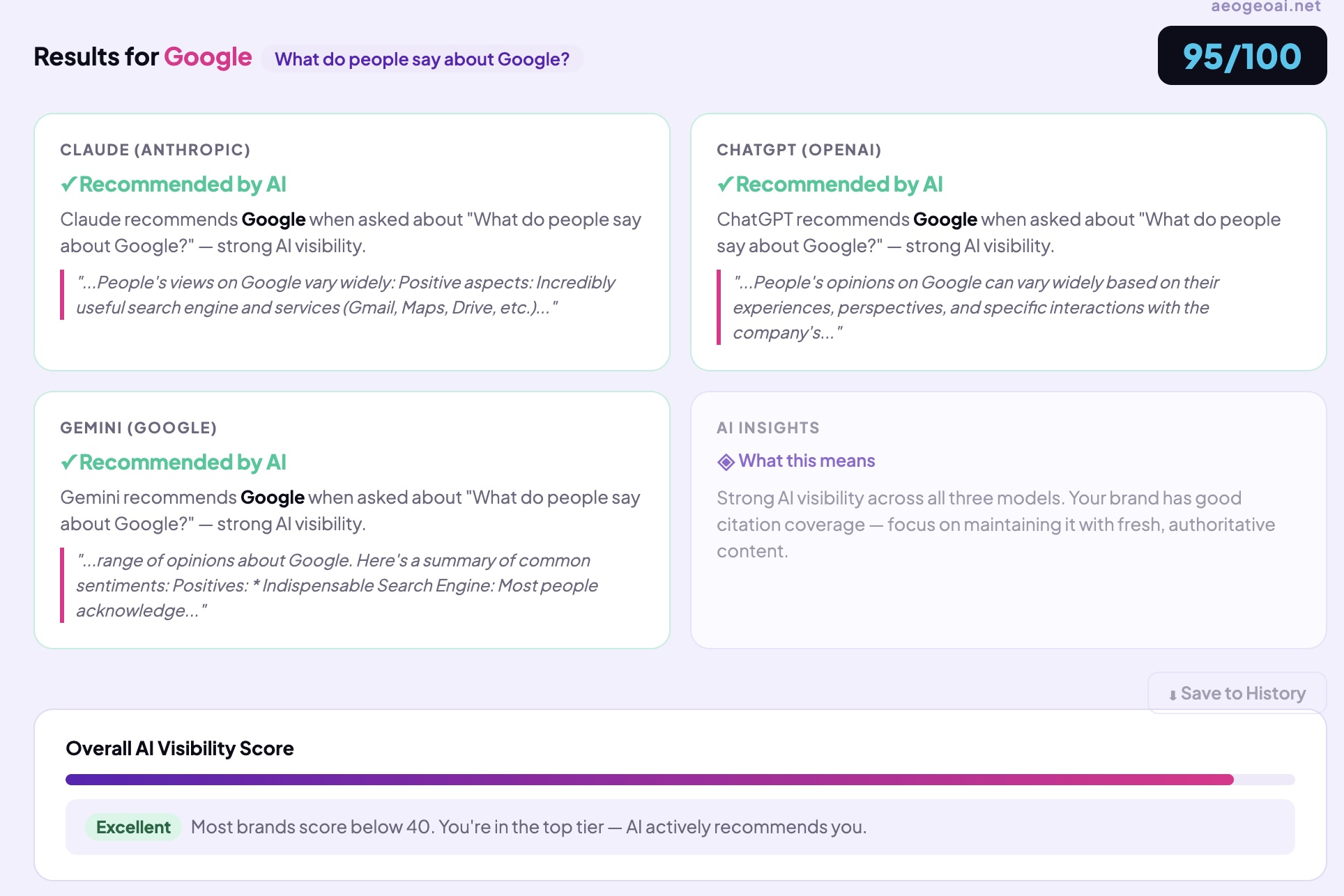
Run all 6-8 questions in the same session. Keeping them in the same session on the same day ensures your monthly data is comparable.
Every check is saved automatically with the date, question, scores and AI excerpts. Your history dashboard shows all your scans in one place, filterable by brand. Compare this month's scores with last month at a glance.
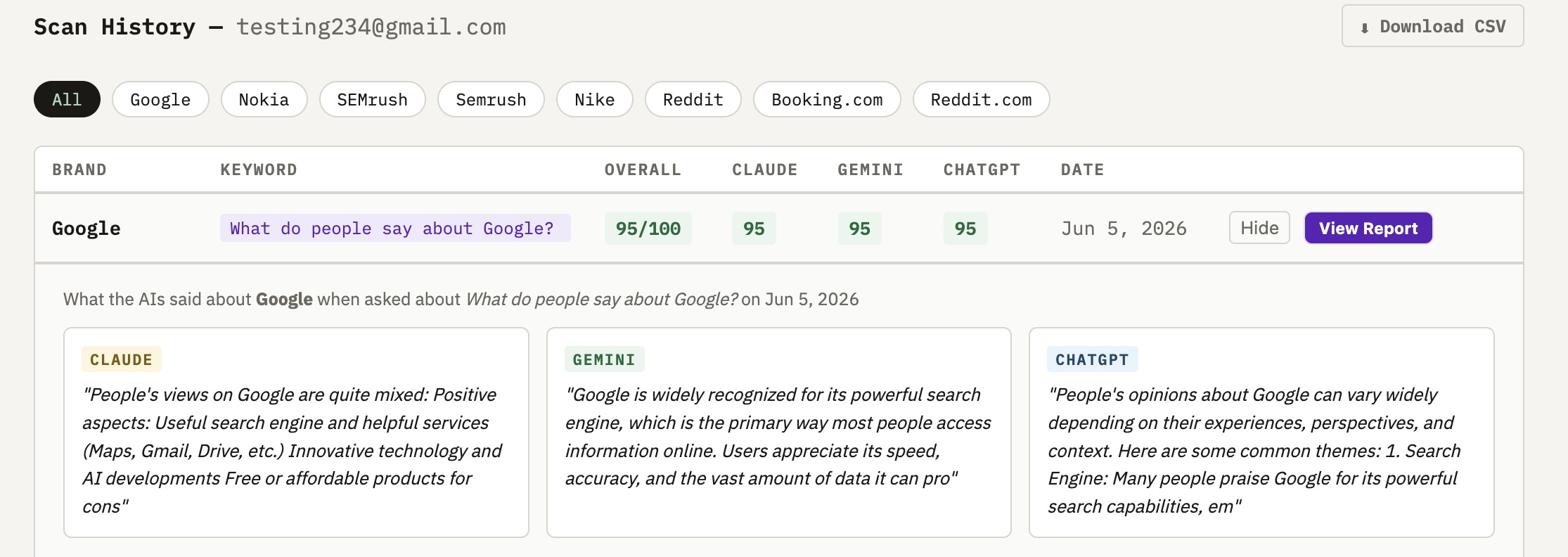
Download your full audit as a CSV file — brand, question, scores per model, AI excerpts and date. Add a column for your own notes: what actions you took that month, what changed in the AI responses, what to focus on next.

Step 3 — Read the Results Correctly
Raw scores only tell part of the story. Here is how to interpret what you find.
Score variation across models is normal — and informative
It is common to score 75 on Claude, 40 on Gemini and 60 on ChatGPT for the same question. This is not a problem with the tool — it reflects genuine differences in how each model represents your brand. A large gap between models tells you that your brand is well established in some training datasets and absent from others. That is actionable information.
Month-on-month trends matter more than absolute scores
A score of 45 is not inherently good or bad. A score that moves from 45 to 52 to 61 over three months is a clear positive signal. A score that drops from 68 to 54 in a single month warrants investigation.
Watch the excerpts, not just the scores
A score can stay flat while the description changes significantly. An AI model might shift from describing your brand neutrally to describing it positively — or from recommending you to recommending a competitor. The excerpts capture that nuance; the score alone does not.
Example: three-month audit
| Month | Question | Claude | Gemini | ChatGPT | Overall |
|---|---|---|---|---|---|
| Month 1 | Is [brand] trustworthy? | 45 | 0 | 50 | 31 |
| Month 2 | Is [brand] trustworthy? | 55 | 30 | 55 | 46 |
| Month 3 | Is [brand] trustworthy? | 50 | 25 | 55 | 43 |
| Month 4 | Is [brand] trustworthy? | 70 | 55 | 70 | 65 ↑ |
Gemini moved from 0 to 55 — likely because new third-party content was published that Gemini's retrieval system picked up. That's the kind of signal that tells you your content strategy is working.
Step 4 — Act on What You Find
An audit without action is just record-keeping. The value is in what you do with the results.
If your scores are low across all models, the most effective interventions are building third-party citations — mentions on review platforms, industry publications, Reddit threads and structured directories that AI models weight heavily in their training data.
If your scores vary significantly between models, focus on the model where you score lowest. Check what that model says about your brand and identify what information it appears to be missing or getting wrong. Then publish content that directly addresses those gaps on authoritative third-party platforms.
If a competitor is being recommended instead of you, read what AI says about them. Understand what signals they have that you do not — and work to build those signals systematically over the following months.
For a full guide to understanding what AI says about your brand, see What Does ChatGPT Say About Your Brand? For a broader overview of the discipline, see our guide to AI reputation monitoring. If your scores are consistently low, our guides on why AI recommends competitors and the AI visibility gap cover the most common causes in detail.
Run your first AI reputation audit in 60 seconds
Free check across ChatGPT, Claude and Gemini — no signup required.
Start your free audit →Frequently Asked Questions
How long does a monthly AI reputation audit take?
With a set of 6-8 questions, a full audit using aeogeoai.net takes around 10-15 minutes. Each check runs across all three models simultaneously, so you are not waiting for each model separately. Pro users can review their history dashboard and export the CSV in a few additional minutes.
How many questions should I include in my audit?
Six to eight is the recommended range. Fewer than six and you risk missing important signals. More than eight and the monthly process becomes time-consuming enough that it gets deprioritised. Start with six and add questions as you identify gaps.
Should I run the same questions every month?
Yes — consistency is essential. Changing your questions month to month makes the data incomparable. If you want to add new questions, add them while keeping the original set intact so you maintain a consistent baseline.
What should I do if my score drops significantly in one month?
Read the AI excerpts carefully and compare them with the previous month. A significant drop usually means either a competitor has gained ground in AI training data, or new negative content about your brand has been published and absorbed. Identify the change and address the underlying cause rather than the score itself.
Can I use this process for client reporting?
Yes — Pro users can export their full audit history as a CSV, making it straightforward to include AI reputation data in monthly client reports. The data includes brand, question, scores per model, AI excerpts and dates.