Most brands discover they have an AI visibility problem the hard way. A potential customer mentions they asked ChatGPT for a recommendation and got three competitor names. A founder searches their own company and finds it missing from every AI-generated list in their category. A marketer runs a query on Perplexity and watches a competitor get recommended with confidence — while their own brand isn't mentioned once.
The problem isn't new. But it's getting more expensive to ignore.
Many founders start by asking: "What does ChatGPT say about my brand?" The answer often reveals whether the business has an AI visibility problem, an AI reputation problem, or both. We've written a full guide to that question — What Does ChatGPT Say About Your Brand? — but this article focuses on the visibility side: whether AI mentions you at all.
AI systems are now the first stop for millions of buying decisions. If your brand isn't visible inside those answers, you're not losing search traffic — you're being written out of the conversation entirely.
What AI Invisibility Actually Means
Being invisible to AI doesn't mean AI has never heard of your brand. It means something more specific: when someone asks an AI system a question your brand should appear in, it doesn't appear.
That question might be:
- "What are the best tools for [your category]?"
- "Which [your industry] companies are worth considering?"
- "Is [your brand] a reliable option for [use case]?"
- "What are the alternatives to [competitor]?"
If your brand isn't showing up in answers to questions like these, you have an AI visibility gap — and it's actively costing you customers who stopped at the AI answer and never searched further.
Why AI Systems Skip Some Brands
AI models don't decide to ignore your brand. They work from patterns in their training data. If your brand has thin, inconsistent, or low-authority coverage in the sources those models weight heavily — industry publications, review platforms, Reddit threads, G2, comparison sites — you won't appear in their outputs, regardless of how good your product actually is.
The most common reasons brands are invisible to AI:
1. Not enough third-party mentions
AI models weight third-party sources heavily. If your brand only appears on your own website and a few social profiles, models won't have enough signal to confidently include you in answers.
2. No clear category definition
If it's ambiguous what category your brand belongs to, AI won't reliably surface you when someone asks a category question. Clear, consistent positioning — "X is a [category] tool for [audience]" — needs to exist across multiple sources.
3. Inconsistent brand information
If your brand name, description, or key facts vary across sources, AI models may suppress or deprioritise your brand to avoid giving users conflicting information.
4. Recent launch or rebrand
Most AI models have a training cutoff. If your brand launched or rebranded after that cutoff, it may simply not exist in the model's knowledge base yet — regardless of how prominent you've become since.
5. Competitors have stronger citation networks
In every category, some brands have dominated the review sites, earned the media mentions, and accumulated the structured citations that AI models draw on. If competitors got there first, they'll appear in answers first too.
The Difference Between Low Visibility and Zero Visibility
There's an important distinction between a brand that scores low on AI visibility and one that scores zero.
A low-visibility brand (score 20–40) is known to AI systems but weakly represented. AI might mention it briefly, describe it vaguely, or include it at the bottom of a list. This is fixable — the brand exists in the training data, it just needs stronger signal.
A zero-visibility brand (score 0–10) isn't appearing at all. AI either has no information about it, or what it has is too thin and inconsistent to surface with confidence.
Both are problems, but the strategy to fix them is different. Low visibility is a content and citation problem. Zero visibility often means starting from scratch — building the third-party presence that gives AI models something to work from.
How to Find Out if Your Brand Is Invisible to AI
You can test your AI visibility yourself in under a minute.
The manual method: Go to ChatGPT, Claude, or Gemini and ask a question your brand should appear in — for example, "What are the best tools for [your category]?" Note whether your brand appears, in what context, and whether the description is accurate.
The problem with the manual method is that it only tells you what one model thinks, in one answer, on one day. A single check gives you a snapshot, not a picture.
The systematic method: Use a tool that tests your visibility across multiple AI models simultaneously, scores each response 0–100, and returns the exact text each model used. This gives you a consistent, comparable baseline you can track over time.
How to Check Your AI Visibility in 60 Seconds
Using aeogeoai.net — free, no account requiredGo to aeogeoai.net and type your brand name. Optionally add a keyword (e.g. "project management software") to test visibility in a specific category context.

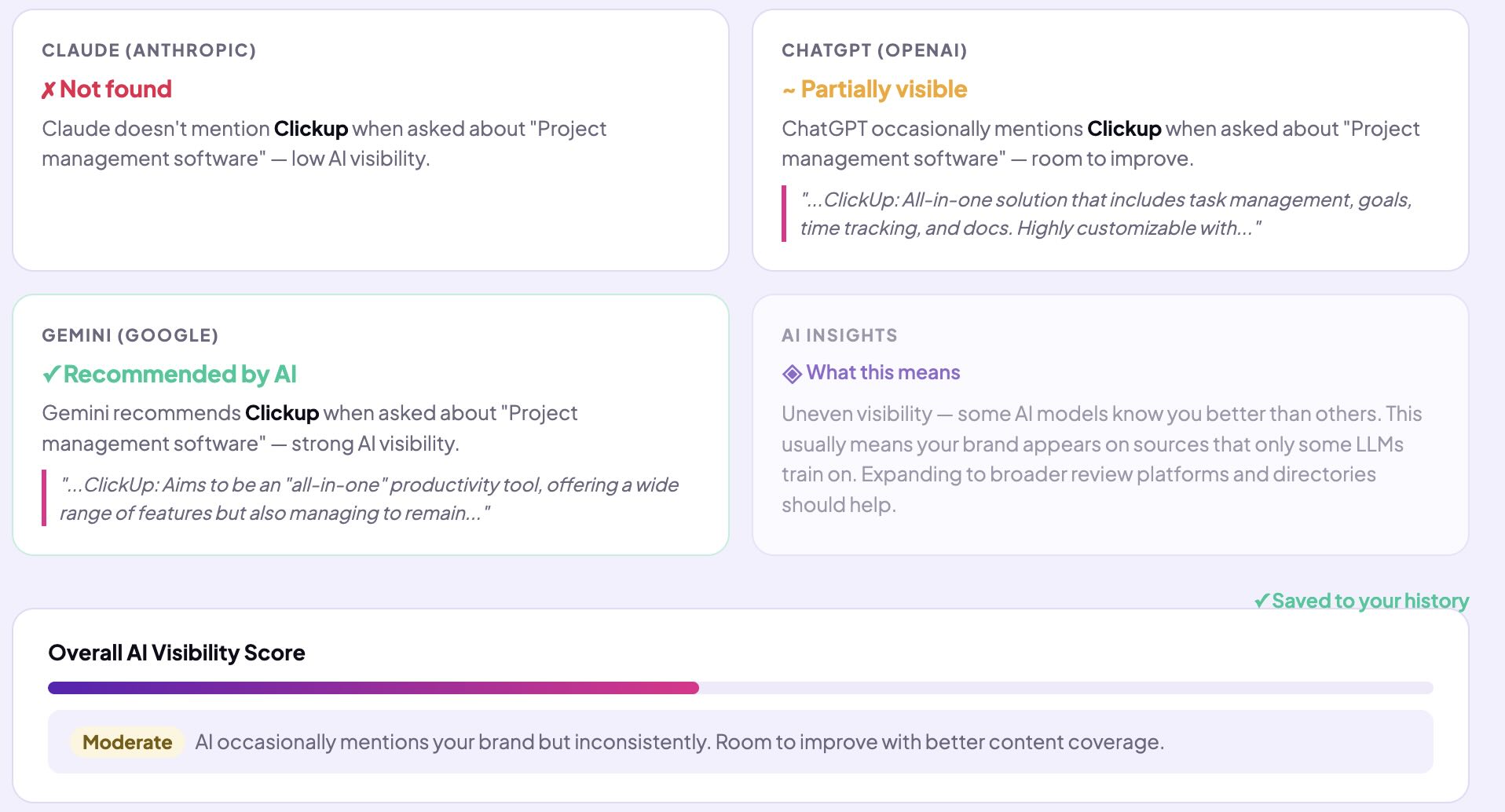
Within seconds, you'll see a visibility score from 0–100 for ChatGPT, Claude, and Gemini — plus the exact sentences each model used to describe your brand.

Click "What AI said" on any result card to see the full AI excerpt — the actual words each model used, not a summary. This tells you whether you're being ignored, mentioned in passing, or recommended with confidence.
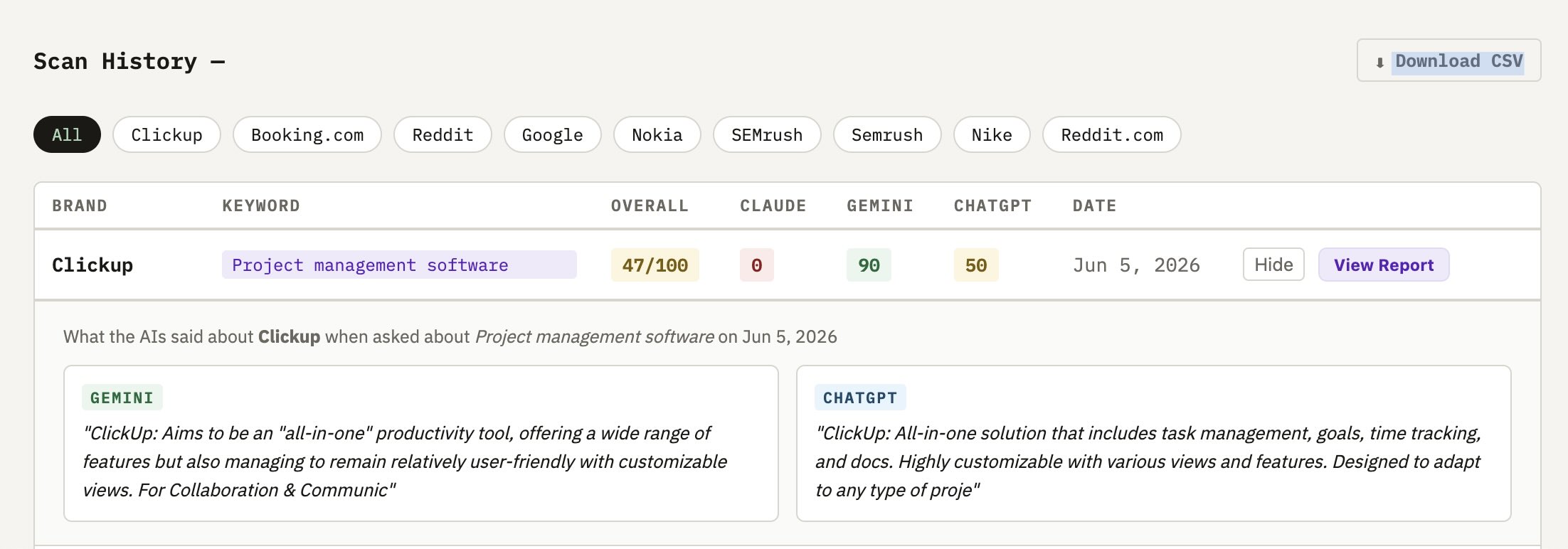
Pro users have every check saved automatically with date, brand, question and scores. Run the same question monthly and measure whether your visibility is improving. Export your full history as a CSV for reporting, analysis and client presentations.
Is your brand invisible to AI right now?
Find out in 60 seconds — free check across ChatGPT, Claude and Gemini, no signup required.
Check your brand free →What an AI Visibility Score Actually Tells You
When you run a check on aeogeoai.net, each model returns a score from 0 to 100. Here's what those scores mean in practice:
70–100: Strong visibility. Your brand is consistently mentioned and often recommended. AI systems have clear, confident information about what you do and who you serve.
40–69: Moderate visibility. Your brand appears but inconsistently. AI might mention you in some queries but miss you in others, or describe you vaguely rather than with confidence. There's room to improve, and the signal is already there to build on.
0–39: Low or zero visibility. Your brand is rarely or never appearing. AI systems either don't have enough information, or what they have is too weak or inconsistent to surface you confidently. This is where the work begins.
The score alone tells you your starting point. The AI excerpt tells you why — whether you're being described inaccurately, mentioned too briefly, or not mentioned at all.
The Cost of Doing Nothing
Brands with stronger citation networks, review profiles and third-party mentions tend to appear more consistently in AI-generated answers. The gap between a well-cited brand and an invisible one can reach 40–60 points — the difference between being the first recommendation and never appearing at all.
AI invisibility compounds over time. Every month that passes with competitors building their citation networks is a month they pull further ahead in AI-generated answers. The gap between an established brand and a new entrant is still closeable — but it widens the longer it's left unaddressed.
How to Fix AI Invisibility: Where to Start
If your brand is scoring low or zero, the fix isn't a single action — it's a systematic build of the signals AI models draw on.
Prioritise third-party review platforms. G2, Capterra, Trustpilot and similar platforms are heavily weighted by AI models. If you're not listed and actively reviewed on these, start there.
Target industry publications. A mention in a relevant industry publication — even a brief one — carries more AI weight than dozens of social posts. Aim for guest articles, product features, or case study inclusion on sites your category's AI answers would naturally reference.
Build structured FAQ content. Publish clear, direct answers to the questions your brand should appear in. Use FAQ schema markup. These make your answers easier for AI models to extract and use.
Standardise your entity definition. Write a consistent one-paragraph description of what your brand is, who it's for, and what category it belongs to. Use it consistently everywhere — website, profiles, press kit, submissions. Consistency across sources is a strong positive signal for AI.
Monitor monthly. You can't optimise what you don't measure. Run the same visibility check on the same questions once a month, track the score, and connect the movement to the actions you took. Over 3–6 months, a clear pattern will emerge.
For a complete framework, see our guide to running a monthly AI reputation audit.
Find out your AI visibility score right now
Free check across ChatGPT, Claude and Gemini — takes 60 seconds, no account needed.
Check your brand free →Frequently Asked Questions
Why doesn't AI mention my brand even though I rank well on Google?
Google and AI models draw on different signals. Google ranks pages based on links, relevance and authority. AI models build their answers from training data — heavily weighted towards third-party mentions, review platforms, forums and industry publications. A brand can rank on page one of Google while scoring zero in AI-generated answers. They are separate problems requiring separate strategies.
How long does it take to improve AI visibility?
Most brands see measurable improvement within 3–6 months of consistent action — particularly when they focus on third-party review platforms and structured content. Changes to AI model outputs aren't immediate, since models are retrained on a schedule rather than in real time. Retrieval-augmented systems like Perplexity can update faster.
Does AI invisibility affect all AI models equally?
Not necessarily. ChatGPT, Claude and Gemini are trained on different data and use different weighting. A brand can score well on one model while being invisible on another. This is why checking across multiple models — and tracking each separately — gives a more useful picture than testing just one.
Can I fix AI invisibility by changing my website?
Your website matters, but it's not the main lever. AI models weight third-party sources most heavily. The single highest-impact action for most low-visibility brands is building a stronger presence on the external platforms AI models reference: review sites, directories, industry publications and authoritative forums.
What's the difference between AI visibility and AI reputation?
AI visibility is whether your brand appears in AI-generated answers. AI reputation is what AI says when it does appear. A brand can be visible but described negatively or inaccurately — that's a reputation problem, not a visibility problem. Both matter, and both should be monitored. See our guide to AI reputation monitoring for the reputation side of the picture.