Every day, potential customers ask ChatGPT, Claude and Gemini questions like:
"Which project management tools would you recommend?"
"What's the best CRM for a small team?"
"Is [brand] a good option for [use case]?"
The AI answers. It names some brands. It ignores others.
The degree to which your brand is mentioned, recommended and accurately described in those answers is your AI brand visibility — and it's one of the most important metrics your marketing team probably isn't measuring yet.
The Framework
AI brand visibility sits at the centre of a connected set of concepts that together describe how brands are discovered, evaluated and recommended by AI systems:
The AI Brand Visibility Framework
The Definition
AI brand visibility is the degree to which a brand appears in, is recommended by, or is accurately described in AI-generated answers across AI systems such as ChatGPT, Claude and Gemini.
It is measured as an AI Visibility Score from 0–100 per model:
Strong AI brand visibility. Your brand is consistently mentioned and recommended. AI systems have clear, confident information about what you do and who you serve.
Moderate AI brand visibility. Your brand appears but inconsistently — in some queries but not others, or described vaguely rather than with confidence.
Low or zero AI brand visibility. Your brand rarely or never appears in AI-generated answers. AI either doesn't know about you or has too little information to surface you confidently.
Why AI Brand Visibility Matters
ChatGPT processes billions of queries monthly. Google AI Overviews appear on a significant percentage of all searches. Perplexity handles millions of research queries daily. Every one of those interactions is a potential brand recommendation.
AI does not recommend brands because they are the best.
AI recommends brands because it has enough evidence to recommend them.
If your brand isn't visible in those answers, you're not losing search rankings — you're losing the conversation entirely. And the buyer who gets their answer from AI often doesn't search further.
AI Brand Visibility vs Traditional SEO
These are separate channels with different signals. The tactics that improve one don't automatically improve the other.
| Traditional SEO | AI Brand Visibility | |
|---|---|---|
| Goal | Rank in a list of links | Appear in generated answers |
| Primary signal | Backlinks and page authority | Third-party citations and evidence |
| Measured by | Ranking position | AI Visibility Score (0–100) |
| Updated | Continuously | On model training cycles |
| Competition | Keyword-based | Category and entity-based |
A brand can rank on page one of Google while scoring zero on AI brand visibility. Both matter — but they require different strategies and different measurement.
The Five Factors That Determine AI Brand Visibility
AI systems surface brands based on the quality and consistency of evidence in their training data. Five factors determine AI brand visibility — together forming the AI Recommendation Formula:
AI Recommendation Formula
Citation Coverage × Category Clarity × Review Presence × Third-Party Authority × Evidence Consistency
The × symbol is conceptual: when any single factor approaches zero, overall AI brand visibility collapses regardless of the strength of the others.
The AI Brand Visibility Gap
When you measure your AI brand visibility and compare it to a competitor's, the difference is your AI visibility gap:
Example — AI Visibility Gap
That gap has a direct commercial consequence. The competitor is being recommended in category answers. You're not. Every buyer who asks an AI for a recommendation in your category and doesn't see your brand is a conversation you're not part of.
The gap is measurable. And measurable problems can be fixed. See our full guide to the AI visibility gap.
Find out your AI brand visibility score right now
Free check across ChatGPT, Claude and Gemini — no signup required, results in 60 seconds.
Check your brand free →How AI Brand Visibility Differs Across Models
ChatGPT, Claude and Gemini don't give the same answer. Each is trained on different data and weights sources differently. A brand can score 72 on ChatGPT and 28 on Gemini for the same query.
ChatGPT draws heavily from Reddit, Wikipedia and structured web content. Strong G2 presence and Reddit discussions improve visibility here.
Gemini weights Google-indexed content, publishers and review platforms. Traditional SEO signals carry more influence.
Claude favours structured, authoritative long-form content. FAQ pages, documentation and well-structured editorial content perform well.
This is why checking AI brand visibility across all three models matters. A single-model check gives an incomplete picture. The gap between models tells you where your evidence is strong and where it's missing.
How to Check Your AI Brand Visibility in 60 Seconds
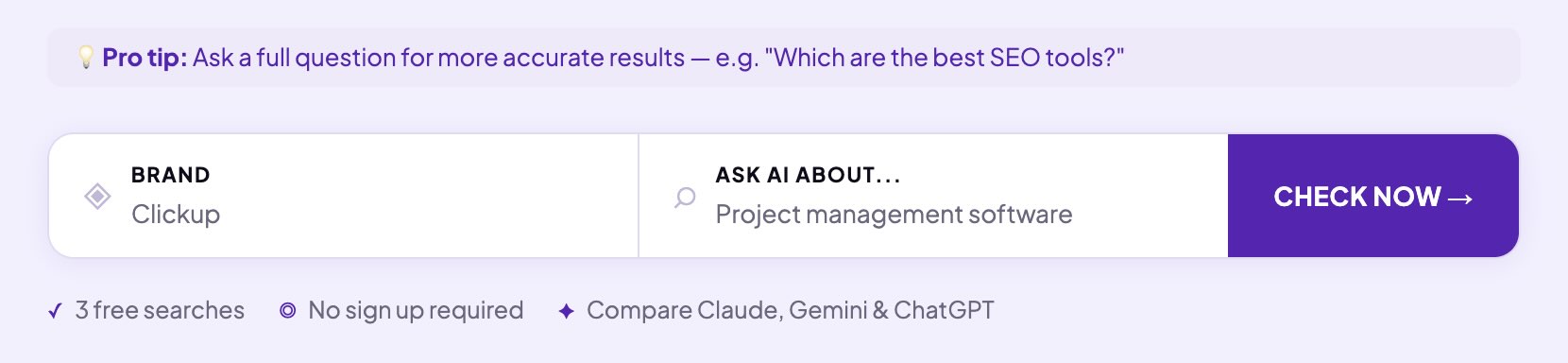
Using aeogeoai.net — free, no account requiredGo to aeogeoai.net. Enter your brand name and the category question your buyers most commonly ask.
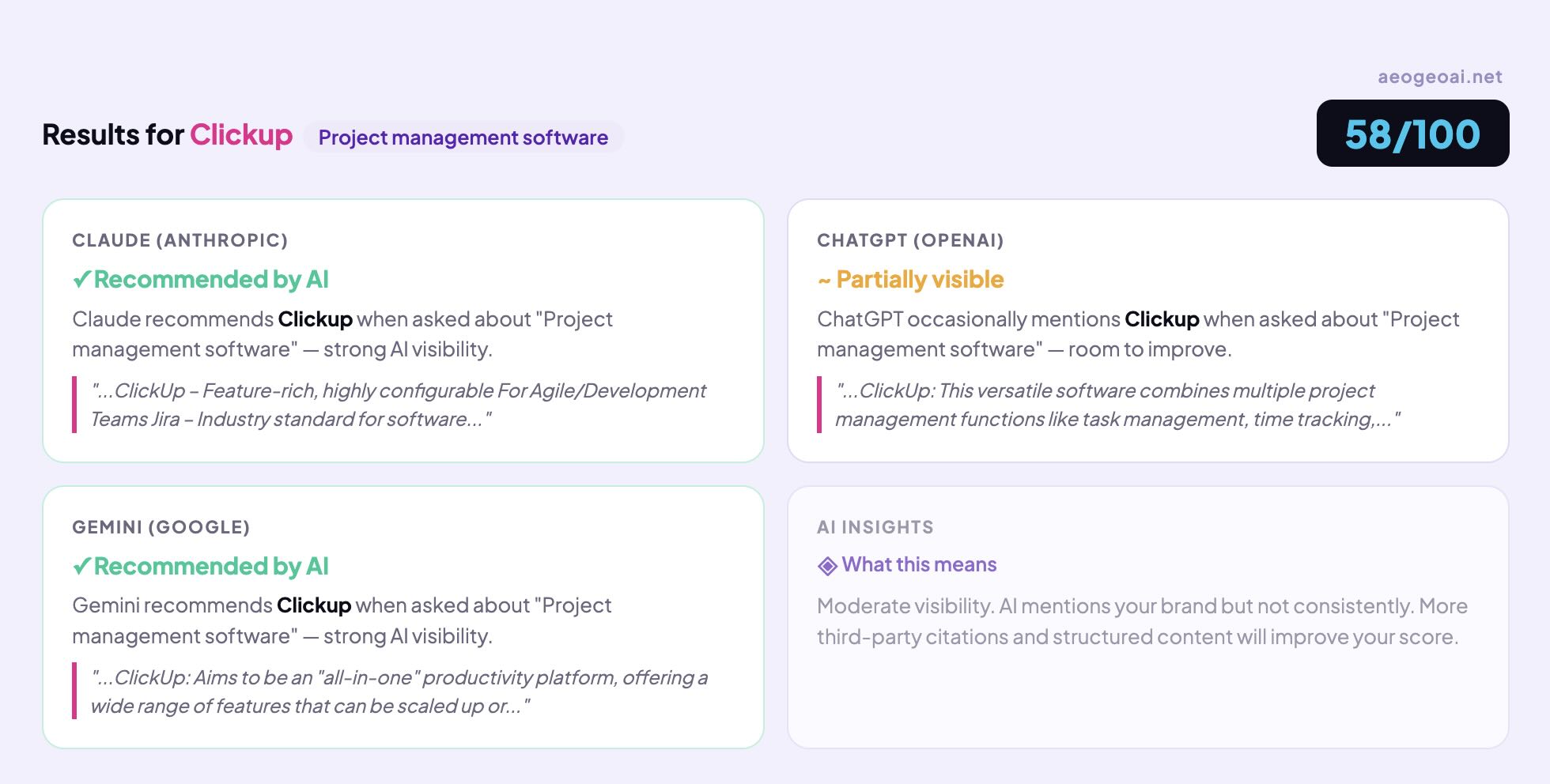
See your score from 0–100 across ChatGPT, Claude and Gemini, plus the exact words each model used to describe your brand.
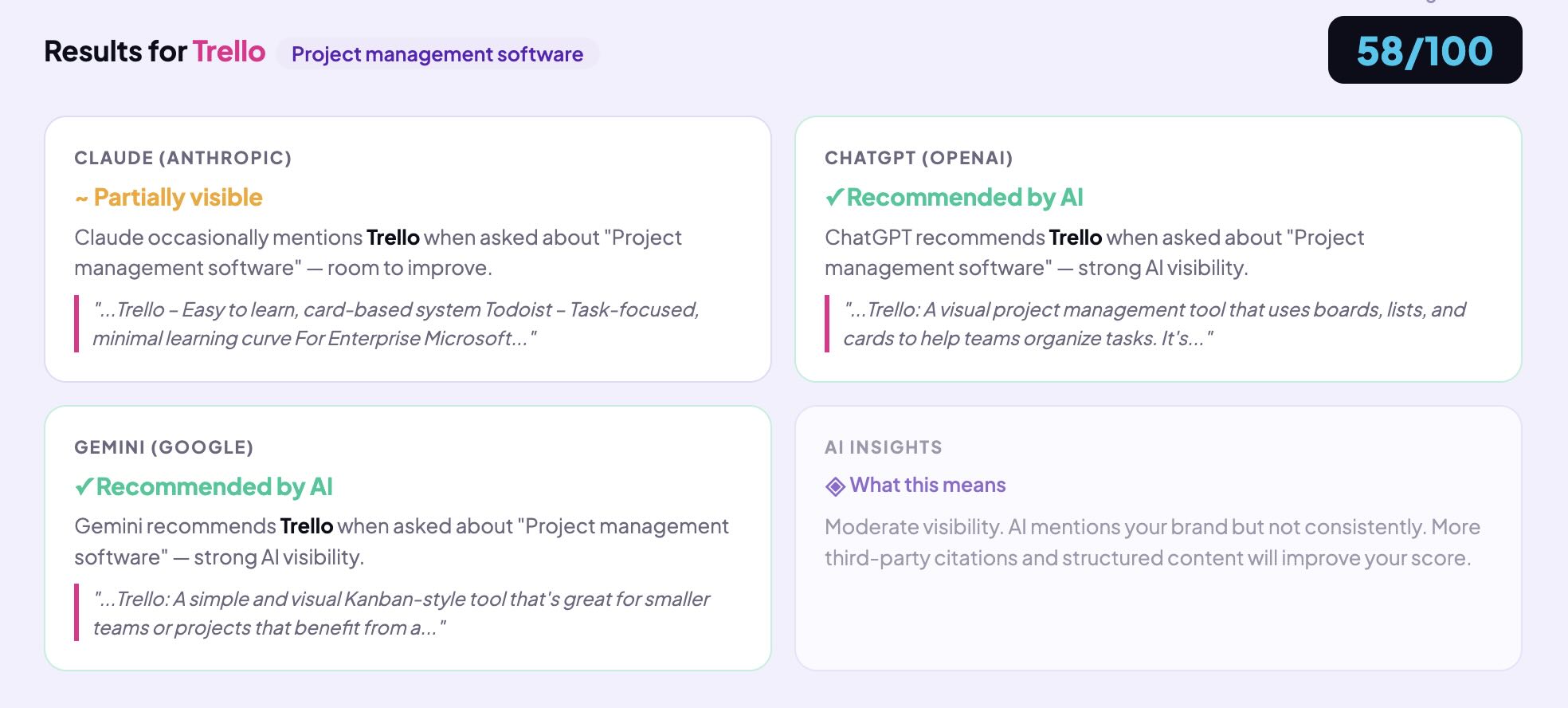
Run the same check for your top competitors. Calculate your AI visibility gap — the number that tells you exactly how far ahead or behind you are.
Save every check with date, brand and scores. Track whether your AI brand visibility is improving. Export to CSV for reporting.
How to Improve AI Brand Visibility
Low AI brand visibility is fixable. The fix isn't fast, but it's systematic and measurable.
Prioritise review platform presence
G2, Capterra and Trustpilot are the highest-leverage starting point for most brands. An active, accurate profile with substantial review volume provides the structured evidence AI models weight most heavily.
Standardise your category definition
Write a single canonical description and deploy it everywhere:
[Brand] is a [category] for [audience].
It does [core function].
It solves [specific problem].
Use this exact description on your website, your G2 profile, your Crunchbase listing, your press kit and every directory submission. Consistency across sources is one of the strongest signals you can give AI systems.
Build third-party citation coverage
Industry publications, comparison articles and forum discussions that reference your brand build the citation network AI draws on. One authoritative mention carries more weight than ten low-authority citations.
Monitor monthly
AI model training cycles mean visibility changes over months. Monthly checks show whether your actions are moving the needle. For a complete monthly tracking framework, see our guide to running a monthly AI reputation audit.
Check your AI brand visibility today
Free check across ChatGPT, Claude and Gemini — see your score, your competitor's score, and exactly what AI says about your brand.
Check your brand free →Frequently Asked Questions
What is AI brand visibility?
AI brand visibility is the degree to which a brand is mentioned, recommended and accurately described by AI systems such as ChatGPT, Claude and Gemini. It is measured as a score from 0–100 per model, where 0 indicates no mention and 100 indicates consistent, confident recommendation.
How do I measure AI brand visibility?
Run a visibility check for your brand across ChatGPT, Claude and Gemini using a category question your buyers would ask. aeogeoai.net does this simultaneously across all three models and returns a 0–100 score per model plus the exact AI excerpts. Free, no account required.
What is an AI Visibility Score?
An AI Visibility Score is a numerical score from 0–100 representing how prominently a brand appears in AI-generated answers for a given query. Scores of 70–100 indicate strong visibility, 40–69 moderate, and 0–39 low or zero visibility. Often abbreviated as ABV score (AI Brand Visibility score).
What is the AI Recommendation Formula?
The AI Recommendation Formula describes five factors that determine AI brand visibility: Citation Coverage, Category Clarity, Review Presence, Third-Party Authority and Evidence Consistency. When any factor approaches zero, overall AI brand visibility collapses regardless of the others.
What is AI brand visibility vs SEO?
Traditional SEO optimises for ranking position in a list of search results. AI brand visibility optimises for inclusion in AI-generated answers, which have no ranked positions — just presence or absence. A brand can rank well on Google while scoring zero for AI brand visibility. Both matter but require different strategies.
What is an AI visibility gap?
The AI visibility gap is the numerical difference between your AI brand visibility score and a competitor's score. A gap of 40+ points indicates a significant evidence deficit. See our full guide to the AI visibility gap.