You ran a check. You read the excerpt. And what came back was wrong.
Maybe ChatGPT described your product as something you stopped doing two years ago. Maybe Gemini listed you in the wrong category entirely. Maybe Claude got your pricing wrong, confused you with a competitor, or gave a vague description that undersells what you actually do.
Whatever it said, it wasn't right — and now it's being repeated to every person who asks about your brand.
This is one of the most frustrating things about AI search visibility: you can't just log in and fix it. There's no correction form, no support ticket, no edit button. The wrong information sits in a model's training data and gets reproduced, confidently, until something changes.
But something can change. Here's how.
Not Every Problem Is a Reputation Problem
Before jumping to a fix, it helps to diagnose exactly what type of problem you have. The two most common AI brand problems look similar on the surface but require different solutions.
AI Visibility Problem
AI doesn't mention your brand at all. You're absent from category answers, comparison lists and recommendation queries. The fix is building stronger third-party citation coverage.
AI Reputation Problem
AI mentions your brand but describes it incorrectly — wrong category, outdated description, confused with a competitor. The fix is correcting the source information AI learned from.
The two issues often overlap, but they require different approaches. If your brand isn't appearing at all, start with our guide to AI visibility. If it's appearing but saying the wrong things, you're in the right place.
Why AI Gets Brands Wrong
AI models don't make things up randomly. When they get your brand wrong, it's usually because one of the following is true:
The wrong information exists somewhere online
Old press releases, outdated directory listings, a product description from three years ago, a review that misidentified your category — AI models surface whatever they found most consistently in training data. If the wrong version of your brand is more prevalent than the right one, the wrong version wins.
There isn't enough information to get it right
When AI models have sparse data about a brand, they fill gaps with inference. They might categorise you based on adjacent brands, describe your product based on your domain name, or give a generic description that technically applies but misses what makes you different.
You've changed but the training data hasn't
Rebrands, pivots, new product lines, pricing changes — AI models have a training cutoff and don't update in real time. The version of your brand in their training data may be months or years behind where you are now.
You share a name or category with someone else
Brand confusion is surprisingly common. If your brand name overlaps with another company, a public figure, or a generic term, AI may blend information from multiple sources into a single inaccurate description.
What You Can't Do
It's worth being honest about the limits here.
You cannot contact OpenAI, Anthropic or Google and ask them to correct what their models say about your brand. There's no business submission process, no verified brand programme, no escalation path for factual errors in model outputs.
You can submit feedback inside ChatGPT or Claude using the thumbs-down button, but there's no evidence this changes what a model says about a specific brand in any measurable timeframe.
What you can do is influence the information landscape the models draw on — so that when they retrain, they find better information about you.
What You Can Do: The Fix
Step 1 — Identify exactly what's wrong
Before you can fix it, document it precisely. Run the same question across ChatGPT, Claude and Gemini and capture the excerpts. Note what is factually incorrect, what is outdated, what is missing, and what is vague or misleading without being technically false. These are different problems requiring different fixes.
Step 2 — Fix the source, not the symptom
If AI got something wrong, the wrong information almost certainly exists somewhere online. Find it and fix it. Common sources of bad AI information include your own outdated About page, Crunchbase and directory listings populated years ago, old G2 or Capterra profile descriptions, press releases from before a pivot, and — highest priority of all — any Wikipedia page that covers your brand or category.
Step 3 — Publish the correct version, clearly and repeatedly
AI models need signal. The correct version of your brand needs to exist across multiple authoritative sources before models will surface it consistently. Start with a single, clear brand definition — and use it everywhere.
AI Brand Definition Formula
Example
Write this definition the way you'd want AI to describe you — because AI will often extract directly from well-structured pages. Use this same sentence, word for word, across your website, review platform profiles, directory listings and press kit. Consistency across sources is one of the strongest signals you can give an AI model.
Beyond the definition, add FAQ schema markup for any fact AI is getting wrong. "Is [brand] a [wrong category]? No — [brand] is a [correct category] that [description]." Schema markup makes these answers easy for AI models to extract.
Finally, get the correct version cited by third parties. A correction on your own site carries limited weight — AI models know you're a biased source. A correct description in an industry publication, a comparison article, or a review platform profile carries more.
Step 4 — Address the specific error type
Different errors need different fixes. Here's a quick reference:
| Problem | Most effective fix |
|---|---|
| Wrong category | Publish content associating you with the correct category; get cited by publications that cover it |
| Old product description | Update all directory listings; get industry coverage of the current product |
| Wrong pricing | Update your own site, G2/Capterra profiles, and any comparison sites referencing old prices |
| Confused with another brand | Entity disambiguation — consistent use of full brand name + category + location across all sources |
| Vague description | More third-party citations; stronger entity definition using the formula above |
Find out exactly what AI is saying about your brand
Free check across ChatGPT, Claude and Gemini — see the exact words each model used.
Check your brand free →How to Audit and Fix an AI Brand Error
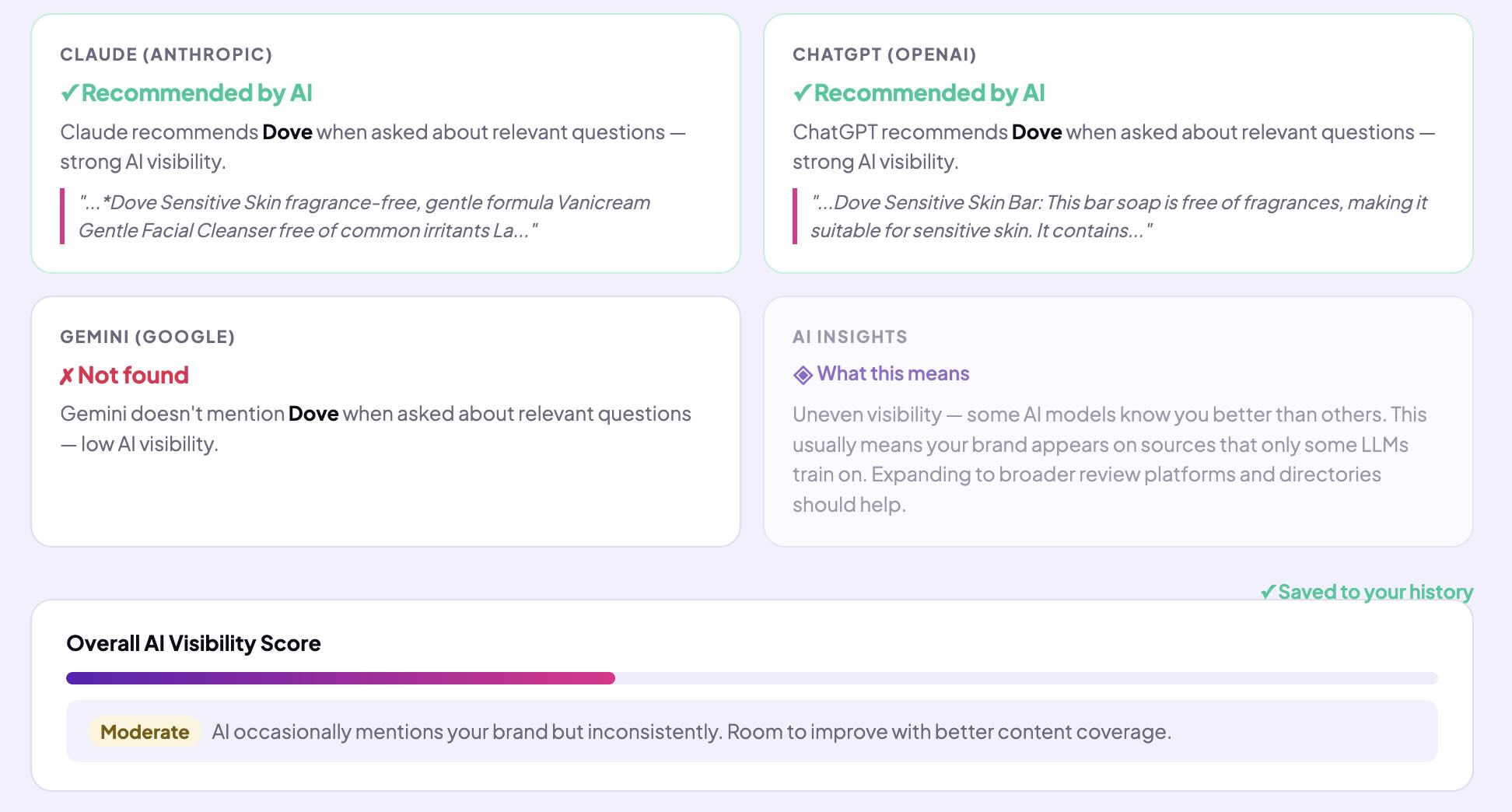
Using aeogeoai.net — free, no account requiredGo to aeogeoai.net, enter your brand name and the question or keyword most relevant to your category. Get scores and excerpts from ChatGPT, Claude and Gemini simultaneously.

Click "What AI said" to see the full text each model used. Copy the exact incorrect description — you'll need it as a reference for finding and fixing the source.

Search for the incorrect description or category term online. Find where AI likely learned it — an old directory listing, outdated profile, legacy press release. Update or contact the source directly.
Update your own site, review platform profiles and any directory listings you control. Use the brand definition formula consistently across all of them. Pitch at least one industry publication for coverage that describes your brand correctly.
Save your baseline check, then recheck with the same question monthly. Track whether the score and excerpt change as you build corrective signal. Export results as CSV for reporting or client presentations.
How Long Does It Take to Fix?
Honest answer: it varies, and there are no guarantees on timing.
AI models don't update continuously. They retrain on a schedule — typically every few months for major models. Changes you make to the information landscape today may not be reflected in model outputs for weeks or months.
Retrieval-augmented systems like Perplexity can update faster, since they pull live web results alongside model knowledge. If Perplexity is describing your brand incorrectly, fixing the top-ranking sources in your category will have a faster effect there than on ChatGPT or Gemini.
What most brands find is that consistent action over 3–6 months produces measurable change. A single corrected listing won't move the needle. A systematic update of every source the model might draw on, combined with new third-party coverage, will.
Running a monthly check using the same questions lets you see when the change happens and connect it to the actions that drove it. See our guide to running a monthly AI reputation audit for a full tracking framework.
See exactly what AI says about your brand today
Free check across ChatGPT, Claude and Gemini — no signup, results in 60 seconds.
Check your brand free →Frequently Asked Questions
Can I contact OpenAI or Google to correct what AI says about my brand?
There is currently no direct submission process for brand corrections with any of the major AI providers. The most effective approach is to improve the quality and consistency of information about your brand across the sources AI models learn from — review platforms, industry publications, directories and your own site.
How do I know if AI got my brand wrong?
The only way to know is to check. Run a visibility check across ChatGPT, Claude and Gemini and read the exact excerpts each model returns. Many brands discover errors they didn't know existed — outdated descriptions, wrong categories, or vague definitions that don't reflect the current product. You can do this free at aeogeoai.net.
What if AI is mixing up my brand with a competitor?
This is a disambiguation problem. The fix is building stronger, more consistent signal that associates your brand name with your specific category, location and differentiators — making it harder for models to conflate you with another entity. It takes time and volume of citations, but it does respond to systematic action.
Does fixing my website help?
Your own site is a useful starting point — particularly structured pages like About, FAQ and product descriptions — but AI models weight third-party sources more heavily than owned content. Fixing your site should be step one, not the whole strategy.
Will AI get my brand wrong again after I fix it?
Possibly. Each time a model retrains, it draws on whatever the current information landscape looks like. If third-party sources revert to old descriptions, errors can resurface. This is why ongoing monitoring matters — not just a one-time fix, but a monthly check to catch drift before it compounds. See our guide to AI reputation monitoring for a long-term framework.